Author: George

  • Compostable or Recyclable? A Cup Carrier Compliance Guide

    Compostable or Recyclable? A Cup Carrier Compliance Guide

    A cup carrier is a small thing to agonize over, until a customer photographs your logo on a tray and asks whether it is actually compostable, or your city passes a packaging ordinance and your supplier’s stock no longer qualifies. The words printed on foodservice packaging—compostable, recyclable, biodegradable, plant-based—are not interchangeable, and they carry real regulatory and reputational weight. If you are branding carriers for a cafe, a catering operation, or a delivery program, it pays to know exactly what those claims mean and which certifications stand behind them before you commit to a print run.

    Compostable, recyclable, biodegradable: three different promises

    Biodegradable is the weakest and least regulated of the three. It only means the material will eventually break down through natural processes, with no promise about how long that takes or what it leaves behind. On its own it is close to meaningless as a purchasing criterion. Compostable is a stricter, testable claim: the material must break down into non-toxic components within a defined time under defined conditions, and legitimate compostable products are certified to a specific standard. Recyclable means the material can be reprocessed into new product—but only if a facility that accepts it exists and the item reaches that facility clean. A carrier can honestly be all three, one, or none, and the differences matter the moment someone tries to actually dispose of it.

    The certifications that back a compostable claim

    When a molded fiber carrier is marketed as compostable, look for the standard it is certified to rather than the adjective alone. In North America the key reference is ASTM D6400 for compostable materials, with ASTM D6868 covering fiber products with compostable coatings; in Europe the equivalent is EN 13432. Certification marks such as TUV OK Compost, CMA, and BPI verify that a product actually meets one of these standards through independent testing. The standards define not just whether a product breaks down but how fast it must do so to earn the claim.
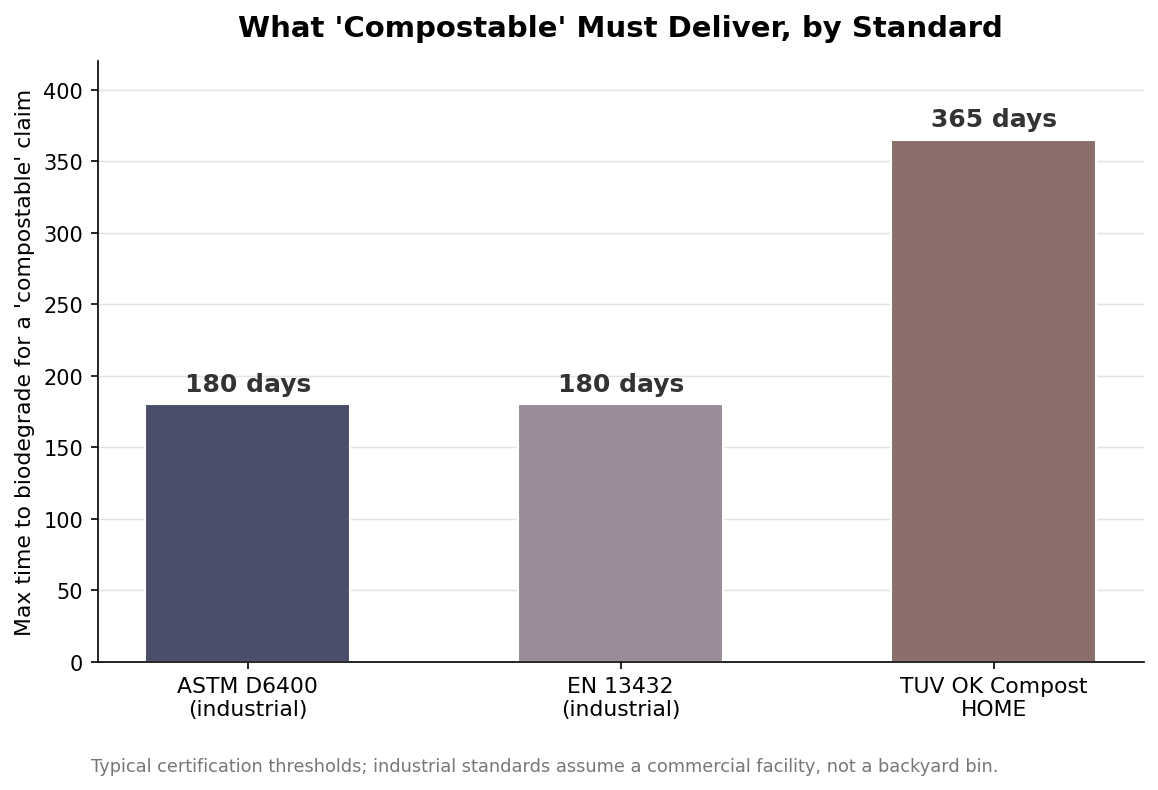
    Bar chart of maximum biodegradation time for a compostable claim: ASTM D6400 and EN 13432 industrial at 180 days, TUV OK Compost HOME at 365 days
    Certification standards cap how long a carrier can take to break down before it may be called compostable.

    The critical distinction hiding in these numbers is industrial versus home. Industrial standards assume a commercial composting facility that reaches high, sustained temperatures; a home-compost certification like TUV OK Compost HOME allows a longer window precisely because a backyard bin runs cooler. A carrier certified only for industrial composting is genuinely compostable, but only where a commercial facility accepts it—which is why reputable products carry a caveat that such facilities may not exist in your area. Certification tells you what the material can do; local infrastructure decides what actually happens to it.

    Recyclable in theory, contaminated in practice

    Molded pulp carriers are made largely from recycled paper fiber, so on paper they slot neatly into the paper recycling stream. In practice, two things get in the way. First, food and liquid contamination: a carrier soaked in spilled coffee is often rejected by recyclers who cannot process wet, soiled fiber, even though the clean version would be accepted. Second, coatings: a paperboard carrier lined with plastic to resist moisture is far harder to recycle than uncoated molded fiber, because the lining has to be separated out. The upshot is that an uncoated molded fiber carrier is frequently better sent to compost than to the recycling bin, while a plastic-lined paperboard one may not be cleanly recyclable at all. Match the disposal claim to the reality of how the item leaves a customer’s hands—usually dirty.

    PFAS and coatings: the fine print buyers miss

    For years, fiber foodservice packaging often relied on PFAS—per- and polyfluoroalkyl substances—for grease and moisture resistance. Those “forever chemicals” have become a regulatory flashpoint, and a growing number of U.S. states now restrict intentionally added PFAS in foodservice packaging. This is the single compliance issue most likely to catch a buyer off guard, because a carrier can be certified compostable and still be a problem if it contains added PFAS. When you source carriers, look explicitly for a no added PFAS declaration, and treat it as a baseline requirement rather than a premium feature. Uncoated molded fiber generally sidesteps the issue; anything with a moisture barrier deserves a direct question about what that barrier is made of.

    How the options really compare at end of life

    Step back from the certifications and the environmental picture is stark. Uncoated molded fiber breaks down on a timescale of months, coated paperboard takes materially longer because of its lining, and rigid plastic carriers persist for centuries. The exact figures depend heavily on real-world conditions and should be read as indicative rather than precise, but the order of magnitude is not in dispute.
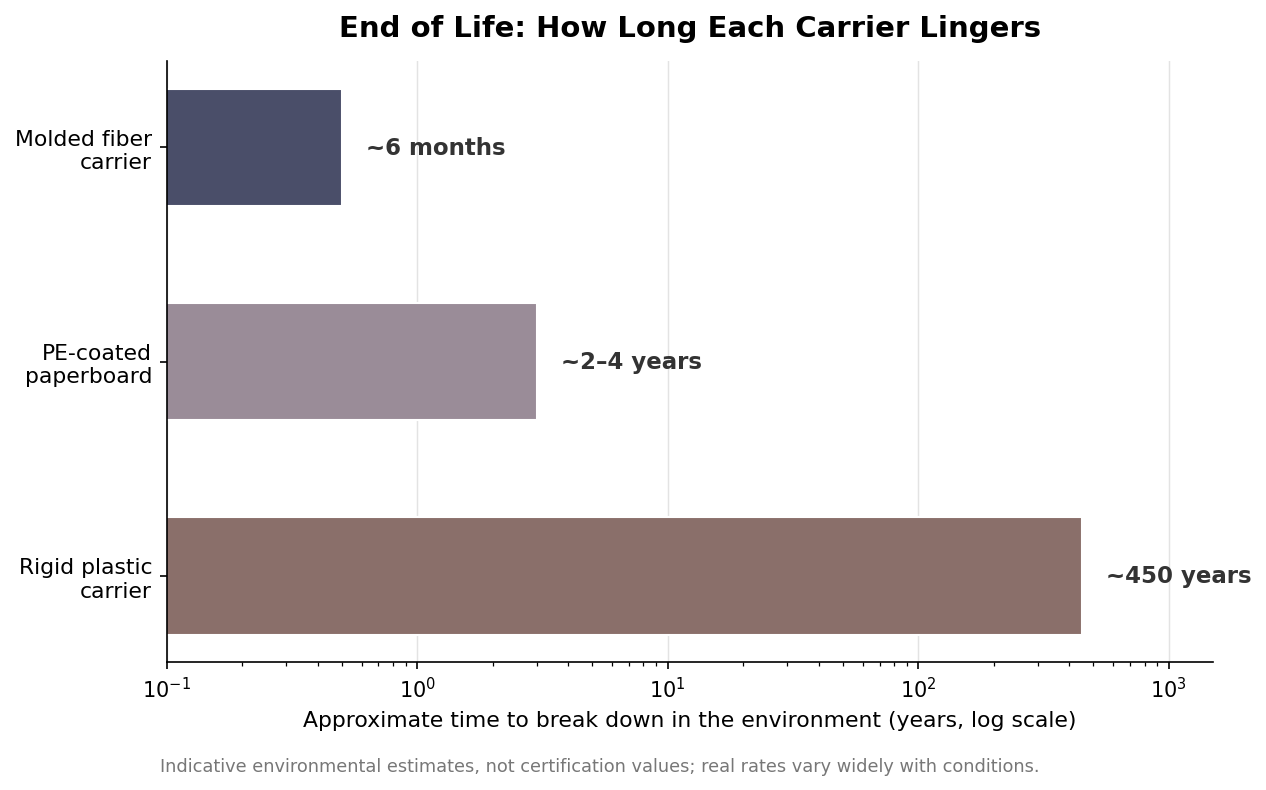
    Log-scale bar chart of approximate environmental breakdown time: molded fiber carrier about 6 months, PE-coated paperboard 2 to 4 years, rigid plastic carrier about 450 years
    Order of magnitude at end of life: molded fiber breaks down in months where plastic persists for centuries.

    This is the comparison worth putting in front of a sustainability-minded customer, with the honest caveat that a compostable carrier only delivers its benefit if it reaches a composter. A certified-compostable tray that ends up in a landfill still beats plastic on its material footprint, but it will not compost in an anaerobic landfill the way it would in a managed facility. The environmental win is real, but it is conditional on where your waste actually goes.

    Specifying a carrier that matches your waste stream

    Pull the decision together around your local reality, not just the label. Decide whether your operation and your customers realistically have access to commercial composting, curbside fiber recycling, or neither, and choose accordingly: certified-compostable uncoated molded fiber where composting exists, clean recyclable fiber where recycling is the realistic path, and a no-added-PFAS declaration in every case. Ask your supplier for the specific certification standard and the composting conditions it assumes, confirm the cup-size range the carrier fits so it works across your menu, and keep any recyclability or compostability messaging you print on the carrier accurate to what a customer can actually do with it. Overclaiming on packaging is both a compliance risk and a trust risk; a modest, accurate claim backed by a real certification is worth far more than a bold one that falls apart under a second look.
  • How to Choose Custom Cup Carriers for Your Brand

    How to Choose Custom Cup Carriers for Your Brand

    How to Choose Custom Cup Carriers for Your Brand: Use Cases and Ordering

    The best way to choose custom cup carriers is to start from how they will be used, then work back to the material, size, and decoration that fit. Custom cup carriers serve very different jobs across food service, e-commerce inserts, retail & branding, and events, and matching the order to the job is what makes custom cup carriers feel purpose-built rather than generic. This guide maps the common use cases and walks through ordering custom cup carriers that fit your brand.

    Whether the cup carriers protects a product, presents a gift, or carries a logo into the world, defining that job first keeps every later decision easy. Purpose drives the spec, and the spec drives the result.

    How brands use custom cup carriers

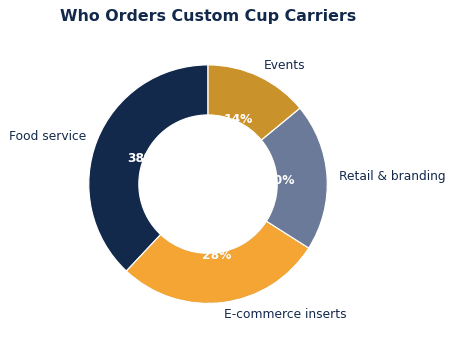
    Custom cup carriers get ordered for a mix of protection, presentation, and promotion, and knowing where yours fall points you to the right build. The breakdown below shows the common uses, from food service to events.

    The common ways brands put custom cup carriers to work.
    The common ways brands put custom cup carriers to work.

    Most orders lean toward one primary job with a secondary benefit — a shipping-focused cup carriers that also brands the unboxing, or a gift-focused one that also protects. Naming your primary use keeps the order focused and the spec appropriate.

    Use case What it needs
    Food service branded, food-safe paper that dresses up a serve
    E-commerce inserts thank-you and instruction cards that build loyalty
    Retail & branding labels and wraps that reinforce the brand
    Events printed pieces that tie a theme together

    Matching material and size to the use

    Once the use is clear, the material and size follow. A protection-first job favors a durable, well-fitted build; a presentation-first job favors a premium material and a clean print; a promotion-first job favors a cost-effective option you can order in volume. Sizing to the product with a small margin keeps the cup carriers looking intentional and performing its job.

    If a single order serves more than one use, spec to the most demanding one so the cup carriers performs everywhere. It is easier to use a slightly sturdier or more premium cup carriers across the board than to discover a bargain option falls short for your most important use case.

    Branding for the impression you want

    Decoration should reinforce the impression the use calls for. Digital and offset printing reproduce full-color art crisply, with spot colors and foil available for a premium touch. For a premium or gift use, lean on finishes and restraint; for high-volume promotion, prioritize a bold, legible logo that reads at a glance and reproduces affordably at scale. Keep branding consistent with the rest of your packaging or merch so everything reads as one system.

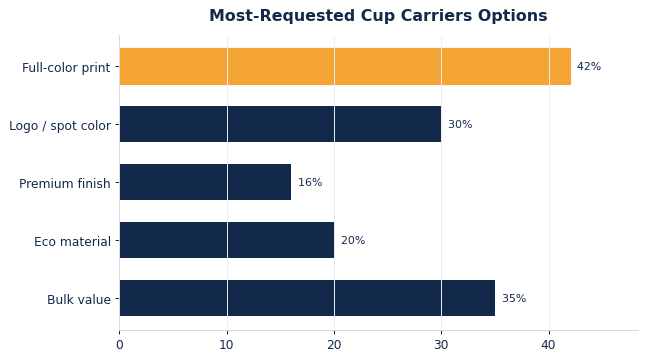
    The most-requested options below reflect what buyers reach for most, and they are a useful starting menu when you brief your order. Whatever you choose, approve a proof so the finished custom cup carriers match the impression you intended.

    The options buyers request most on custom cup carriers.
    The options buyers request most on custom cup carriers.

    Getting the size and details right

    Even with the use and material decided, the details are what make custom cup carriers feel finished. Confirm the size and weight against the product with a small margin, check the print area for your chosen size so the logo sits cleanly, and decide on any finishing touches before you brief the order. These small confirmations up front are what separate a cup carriers that looks intentional from one that looks close-enough.

    A sample or proof is the cheapest insurance you can buy on a cup carriers order. A physical sample lets you judge the material and print in hand, while a digital proof confirms artwork, color, and size and weight before the full run. Spending a few minutes here prevents the far larger cost of reworking a finished order of custom cup carriers that missed on a detail.

    Ordering: quantities, lead time, and reorders

    A smooth cup carriers order comes down to a few basics: order for real demand plus a small overage, send print-ready artwork early, and confirm lead time against any deadline so production and shipping fit your timeline. Per-unit cost drops with volume, so consolidating a season’s needs into one run is usually more efficient than repeated small orders.

    Keep your approved artwork and spec on file so reorders are a quick repeat rather than a fresh setup each time — consistency across runs keeps your brand looking deliberate.

    Coordinating with the rest of your brand

    Custom cup carriers rarely stand alone; they sit alongside your other packaging, print, or merch, so coordinating them strengthens the whole brand. Carrying the same logo, colors, and tone across your cup carriers and your other pieces makes everything read as one deliberate system rather than a set of one-off orders. That consistency is what makes a brand feel established, and it costs nothing extra to plan.

    Coordination also simplifies buying over time. Standardizing on a material, size, and decoration you are happy with turns future orders into simple repeats, and it keeps every batch matching the last. A little upfront alignment pays back every time you reorder custom cup carriers.

    Frequently asked questions about custom cup carriers

    What are custom cup carriers used for?

    Custom cup carriers serve a mix of protection, presentation, and promotion across food service, e-commerce inserts, retail & branding, and events. Most orders lean toward one primary job with a secondary benefit, so naming your main use is the first step in speccing the right cup carriers.

    How do I match custom cup carriers to my use?

    Let the use drive the spec: durable and well-fitted for protection, premium and clean for presentation, cost-effective and bold for promotion. If one order serves several uses, spec to the most demanding one so the cup carriers performs everywhere.

    How should I brand custom cup carriers?

    Digital and offset printing reproduce full-color art crisply, with spot colors and foil available for a premium touch. Choose finishes and restraint for premium or gift uses, and a bold, legible logo for high-volume promotion, keeping the branding consistent with your other packaging or merch so it all reads as one system.

    How far ahead should I order custom cup carriers?

    Order for real demand plus a small overage, send print-ready artwork early, and confirm lead time against any deadline so production and shipping fit your timeline. Consolidating a season’s needs into one run is usually more efficient than repeated small orders.

    Can I reorder easily?

    Yes. Keeping your approved artwork and spec on file makes reorders a quick repeat rather than a fresh setup, and it keeps every batch of custom cup carriers matching the last for a consistent brand look.

    Do I need a sample before ordering custom cup carriers?

    A sample is worth it for a first order or a new material, since judging feel and print in hand removes the guesswork. For a straightforward reorder of custom cup carriers you have bought before, a digital proof confirming artwork and size and weight is usually enough.

    Match the cup carriers to the job, spec it deliberately, and approve a proof, and your order will do exactly what you needed. For the full material and sizing breakdown, see our companion guide, our Custom Cup Carriers: Materials, Sizing & Branding Guide, and browse our our shop to get started.

    Not sure which custom cup carriers fit your use?

    Tell us how you’ll use them and we’ll match the material, size, and branding to the job.

    Get a Quote

  • Custom Cup Carriers: Materials, Sizing & Branding Guide

    Custom Cup Carriers: Materials, Sizing & Branding Guide

    Custom Cup Carriers: A Materials, Sizing, and Branding Guide

    Getting custom cup carriers right comes down to three decisions: the material, the size or spec, and how you brand them. Make those well and you end up with custom cup carriers that protect and present your product, reinforce your brand, and land on budget. This guide walks through the material options, how to size and spec your order, and how to decorate custom cup carriers so they do real work for your brand rather than just checking a box.

    Whether you are ordering your first run or reordering at scale, the same fundamentals apply. Choosing custom cup carriers deliberately — material to job, size to product, decoration to brand — is what separates an order you are proud of from one you settle for.

    Why custom cup carriers matter for your brand

    Custom cup carriers are more than a commodity; they are a touchpoint brands experience directly. A well-chosen, well-branded option signals quality and attention to detail, while a generic one quietly undercuts an otherwise strong product. Because custom cup carriers are seen and handled, they carry your brand into the world every time they are used.

    That visibility is exactly why it pays to spec custom cup carriers intentionally. The material sets the feel, the size sets the fit and cost, and the decoration sets the impression — and getting all three aligned turns a functional item into a genuine brand asset.

    Materials and options compared

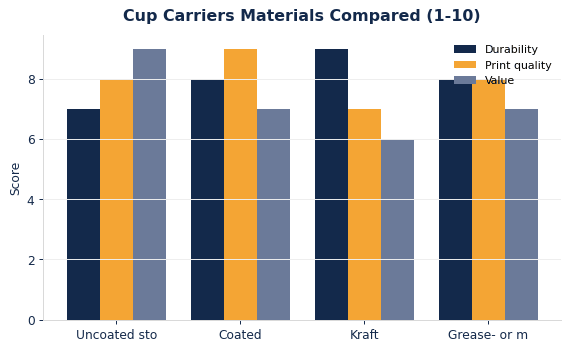
    The common materials for custom cup carriers each trade off durability, print quality, and cost: uncoated stock, coated / gloss stock, kraft / recycled, and grease- or moisture-resistant. The right pick depends on how the cup carriers will be used, the look you want, and your budget. The chart and table below compare the main options so you can match material to job.

    How common cup carriers materials compare on durability, print quality, and value.
    How common cup carriers materials compare on durability, print quality, and value.

    As a rule of thumb, choose a recyclable or natural material when eco positioning matters, a coated or laminated option when you want vivid full-color print, and a premium build when the cup carriers is part of a gift or high-end presentation. When in doubt, request a sample so you can judge feel and print before committing to a full run.

    Material / option Best for
    Uncoated stock natural, writable surface with a matte look
    Coated / gloss stock vivid color and a polished finish
    Kraft / recycled eco-forward, warm natural tone
    Grease- or moisture-resistant food-safe performance where needed

    Sizing and specs

    Sizing is where many cup carriers orders go wrong, so measure before you order. Custom cup carriers typically range from a small insert card up to a full wrap or liner sheet, and the right size and weight depends on the product or use they serve. Too small and the fit is tight or the product is exposed; too large and you pay for material you do not need and lose a clean, intentional look.

    When a measurement falls between standard options, size to the product with a small margin rather than guessing. Confirming the size and weight on a proof or sample before a large run prevents the costly mistake of a full order that does not fit, which is far more expensive to fix than a five-minute check up front.

    Branding and decoration

    Decoration is what turns a plain cup carriers into a branded one. Digital and offset printing reproduce full-color art crisply, with spot colors and foil available for a premium touch. Match the method to your artwork and budget: simple logos reproduce cleanly and cheaply, while detailed, full-color designs shine with the right process on the right material. Keep the artwork vector where possible and confirm the print area for your chosen size.

    Restraint usually reads as premium. A clean logo, one or two brand colors, and quality material almost always look more considered than a busy, over-printed design. Approving a proof before the run protects both the look and the budget, especially on a large order of custom cup carriers.

    Ordering and budget

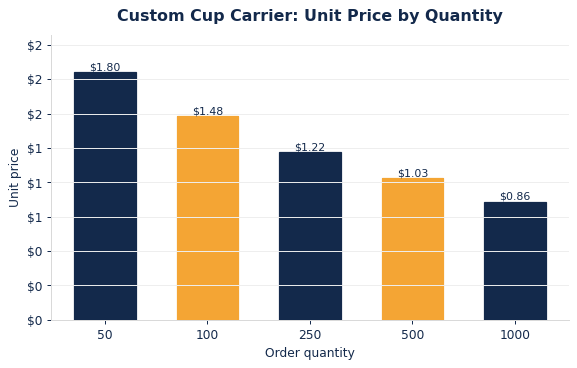
    Per-unit cost on custom cup carriers falls steadily with volume as setup amortizes across more pieces, so ordering for real demand rather than a token first batch is usually the efficient move. The curve below shows how pricing typically improves with quantity, which helps you plan an order that balances cash and cost.

    Typical per-unit cup carriers pricing as order quantity increases.
    Typical per-unit cup carriers pricing as order quantity increases.
    Ordering for a recurring need? A single larger run lowers the unit cost and keeps your branding consistent, while a small overage covers reorders and the occasional damaged piece without a rush order.

    Common mistakes to avoid

    A few avoidable missteps account for most disappointing cup carriers orders. Ordering before measuring is the biggest, followed by choosing a material for price alone without considering how the cup carriers will actually be used, and skipping the proof on a large run. Each is easy to prevent with a few minutes of planning, and each is expensive to fix once a full order is produced.

    The other common trap is over-designing the artwork. Cramming in too many colors, effects, or details can muddy the print and raise the cost, especially on textured or recycled materials. Simplifying the design to a clean, legible mark almost always improves both the look and the price of your custom cup carriers.

    Frequently asked questions about custom cup carriers

    What material is best for custom cup carriers?

    It depends on the use: choose a recyclable or natural material for eco positioning, a coated or laminated option for vivid full-color print, and a premium build for gifting or high-end presentation. Request a sample to judge feel and print before a full run of custom cup carriers.

    How do I choose the right size?

    Measure the product or use the cup carriers serves, then size to it with a small margin so the fit is clean without wasting material. When a measurement falls between standard options, size up slightly and confirm the size and weight on a proof before ordering in volume.

    How are custom cup carriers branded?

    Digital and offset printing reproduce full-color art crisply, with spot colors and foil available for a premium touch. Match the method to your artwork and budget, keep the art vector where possible, confirm the print area for your size, and approve a proof so the finished custom cup carriers match your intent.

    How does pricing work, and is there a minimum?

    Per-unit cost drops with quantity as setup amortizes across the run, so larger orders are more cost-effective. Order for real demand plus a small overage rather than a token batch, and consolidate recurring needs into one run for the best price.

    Can I get a sample or proof before ordering?

    Yes, and it is strongly recommended. A physical sample lets you judge material and print, and a digital or physical proof confirms your artwork, color, and size and weight before a full run — a small step that prevents a costly mistake on a large order.

    What do you need to quote custom cup carriers?

    To quote accurately we need the size and weight or the product they serve, the quantity, your material preference, and your artwork or a description of the branding. With those details we can recommend the right material and size and give you pricing for the run, and a proof follows once the order is confirmed.

    Whatever you order, send vector artwork, confirm material and size and weight, and approve a proof before production. For help matching custom cup carriers to a specific use, see our companion guide, our How to Choose Custom Cup Carriers for Your Brand, and explore our our shop to start your order.

    Ready to order custom cup carriers?

    Tell us your product, quantity, and branding and we’ll match the material, size, and decoration for you.

    Get a Quote

  • How Many Cup Carriers Should You Order?

    Call or Text us: (929) 605-4397

    How Many Cup Carriers Should You Order?

    Most cafes burn through far more cup carriers than they expect, and running out mid-rush means loose cups, spilled drinks, and a counter line that stops moving. Here is the simple math for sizing your first custom order, plus the reorder rhythm that keeps unit costs down.

    Start with your multi-drink ticket count

    Carriers are not used on every order — only on tickets with two or more drinks to go. Pull a normal week from your POS and count the to-go tickets with 2+ drinks. That weekly number, times 1.15 for waste and double-carrying, is your true weekly burn.

    The order-size sweet spot

    Custom-printed carriers price in tiers, and the jump from a small run to a mid run usually cuts the per-unit cost by 20–35%. As a rule of thumb:

    Weekly burnRecommended first orderCoverage
    Under 1502,000~3 months
    150–4005,000~3–4 months
    400–1,00010,000~4 months
    Over 1,00015,000+quarterly reorder

    Three to four months of stock is the sweet spot: deep enough into the price tiers to matter, small enough that storage stays manageable and your artwork can still evolve.

    Do not forget storage and seasonality

    Flat-packed paperboard carriers store compactly — a case of 500 is about the size of two shoe boxes — but molded pulp trays are bulkier, so cap pulp orders at what your back room actually fits. If you run an iced-drink summer spike or a holiday latte season, time the big order to land four to six weeks before it starts.

    Reorder before you think you need to

    Custom printing has a production and shipping lead time of about two weeks. Set a reorder trigger at six weeks of remaining stock and you will never be forced to bridge the gap with plain stock carriers that waste the branding you paid for.

    Design your custom cup carriers

    Tell us your cup sizes, volume, and artwork and we will spec the material, capacity, and printing that fit your cafe or concession.

    Get a Quote

    Home · About · Blog

    GET A QUOTE
  • Molded Pulp vs. Paperboard Cup Carriers: Which Fits Your Counter?

    Call or Text us: (929) 605-4397

    Molded Pulp vs. Paperboard Cup Carriers: Which Fits Your Counter?

    Pulp trays and paperboard carriers both get four drinks out the door, but they behave very differently on a busy counter, in storage, and on your brand. Here is how to pick the right one for your cafe, concession stand, or catering run.

    How they differ

    Molded pulp trays are pressed from recycled fiber into a rigid tray with deep cup wells. Paperboard carriers fold flat and pop open, with die-cut holes or a clip design that grips the cup sleeve. Both hold standard 8–24 oz cups; the differences are rigidity, storage, and print quality.

    Where pulp wins

    Pulp is the stability king. The deep wells cradle heavy iced drinks and open-lid cups, which makes pulp the safe pick for delivery orders, drive-through windows, and stadium concessions where carriers get carried far and set down hard. It also reads as eco-friendly at a glance, which matters to many customers.

    Where paperboard wins

    Paperboard wins on branding and back-room space. The flat surfaces take full-color print beautifully — logo, pattern, social handle, a QR code — while pulp is limited to a one-color stamp or a printed label. A case of flat paperboard carriers takes roughly a quarter of the shelf space of the same count in pulp trays, and the per-unit cost is usually lower at every volume tier.

    The quick decision guide

    Your situationPick
    Delivery-heavy, long carries, iced drinksMolded pulp
    Brand visibility is the goalPrinted paperboard
    Tight storage spacePaperboard
    Catering drop-offs of 6–8 drinksPulp catering tray

    Plenty of shops run both: printed paperboard for the counter rush, pulp trays for delivery platforms and catering. Because both are custom-printed against the same artwork, your brand stays consistent either way.

    Design your custom cup carriers

    Tell us your cup sizes, volume, and artwork and we will spec the material, capacity, and printing that fit your cafe or concession.

    Get a Quote

    Home · About · Blog

    GET A QUOTE