Author: George

  • Do Custom Cup Carriers Hold Up? A Durability, Storage and Care Guide

    Do Custom Cup Carriers Hold Up? A Durability, Storage and Care Guide

    Published November 16, 2026. Last updated November 16, 2026.

    Custom cup carriers hold up well when you match the carrier style to the drink and keep stock dry, flat and away from steam. Custom Cup Carriers offers molded pulp trays for wet iced orders and kraft or claycoat paperboard for crisp printing, and this guide covers storage, handling, delivery and when worn stock should be replaced.
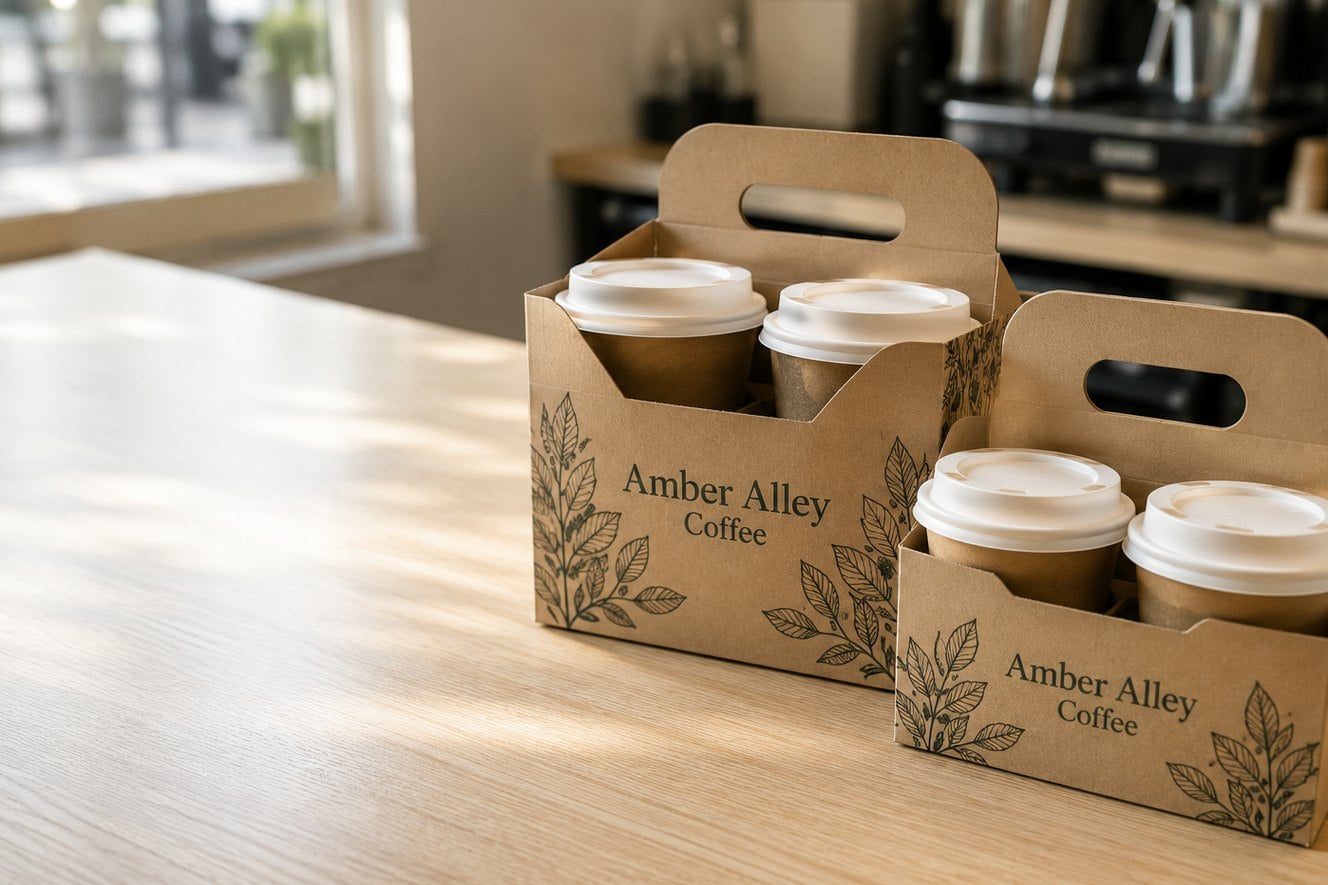
    Do Custom Cup Carriers Hold Up? A Durability, Storage and Care Guide - custom printed cup carriers from Custom Cup Carriers
    Custom cup carriers with a logo, produced by Custom Cup Carriers.
    Key facts
    • Molded pulp drink trays tolerate condensation best on long iced deliveries
    • Claycoat board resists scuffs and keeps full-color printing bright
    • Store cartons flat, sealed, off the floor and away from steam
    • Free mockup within 24 hours, standard turnaround about 2 weeks

    Do custom cup carriers actually hold up under hot and iced drinks?

    Custom cup carriers hold up well when the carrier style matches the drink and the carriers are stored dry and flat until service. Custom Cup Carriers builds each style from food-safe board or molded fiber, and most durability problems trace back to a mismatch between carrier and order or to cartons kept in a damp, hot spot rather than to the material itself.

    Hot drinks and iced drinks stress a carrier in different ways. A hot latte sends steam and warmth into the cell walls, which can soften thin board over a long carry. An iced drink sweats, and that condensation runs down the cup into the base of the cell. A carrier that handles one well is not automatically the best choice for the other.

    The good news is that durability is mostly a planning decision you make once. Pick the right style for your heaviest and wettest orders, keep stock in the right place, and train staff on assembly, and your cup carriers will look the same at the customer’s door as they did at the counter.

    Which cup carrier material lasts longest for each kind of order?

    Molded pulp drink trays are the sturdiest choice for wet, heavy iced orders, while paperboard carriers in kraft or claycoat board give you the cleanest print and hold up best for hot drinks and short carries. Custom Cup Carriers offers both, so you can match material to the order rather than forcing one style to cover everything.

    Carrier styleMaterialHolds up best forWatch out for
    Molded pulp drink trayMolded fiberIced drinks, melting ice, long delivery drivesSimpler print area than paperboard
    4-cup paperboard carrierKraft or claycoat boardMixed hot and iced counter ordersLong exposure to pooled water
    Handled cup caddyFolded board with a carry handleWalk-away orders, drive-thru handoffsOverfilling cells past their rated cup size
    2-cup clip carrierDie-cut boardPairs of drinks on short carriesHeavy oversized cups on a long walk
    8-cup catering trayRigid corrugatedGroup orders, vehicle transportStoring assembled trays in humid rooms

    Claycoat board has a smoother, sealed surface that resists scuffing and keeps full-color printing crisp. Kraft board has a natural look and a slightly more absorbent surface, so it shows water marks sooner if stock gets damp. Neither is wrong; choose the finish that fits your brand and your storage conditions.
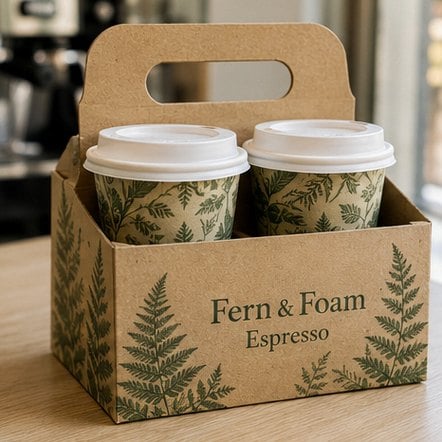
    2-Cup Clip Carrier - one of the custom cup carriers styles from Custom Cup Carriers
    2-Cup Clip Carrier.

    How should I store custom cup carriers so they stay stiff and print-perfect?

    Store custom cup carriers flat, in their original cartons, off the floor and away from steam, sinks and direct sun. Those four habits protect both the stiffness of the board and the look of your printed logo, and they cost nothing to set up.

    Board and molded fiber both absorb moisture from the air. A carton parked next to the dish pit or an espresso steam wand slowly picks up humidity, and carriers that were crisp on delivery day start to feel limp. Heat from an oven line or a sunny window can also warp flat blanks so they no longer fold cleanly.

    1. Keep cartons sealed until you need a fresh stack at the counter.
    2. Shelve cartons on a rack or pallet, never directly on a concrete or tile floor that can wick moisture.
    3. Stack cartons squarely so weight presses evenly and blanks stay flat.
    4. Keep a small working stack at the station and refill it from the back, rather than leaving a whole open carton by the bar.
    5. Rotate stock so older cartons are used first when a reorder arrives.

    If your back room is small, store fewer cartons on site and stage reorders more often. Custom Cup Carriers keeps your approved artwork on file, so repeat orders move quickly.

    What makes printed cup carriers fade, scuff or smear before they reach the customer?

    Printed cup carriers mostly lose their look from abrasion and moisture, not from the printing process. Carriers dragged across a counter, packed tightly against rough cartons or handled with wet hands pick up scuffs and water marks that make a sharp logo look tired.

    A few causes come up again and again. Staff slide finished carriers across a wet counter. Open stacks sit under a dripping ice bin. Carriers are pressed into overfilled delivery bags where they rub against food containers. Each of these is a handling issue that a quick change at the station fixes.

    • Dry the handoff counter before setting down a loaded carrier.
    • Keep the working stack under the counter rather than beside the ice well.
    • Handle printed panels by the edges when assembling carriers.
    • Choose claycoat board if your brand relies on full-color artwork that must stay bright through heavy handling.

    When you review your free mockup from Custom Cup Carriers, ask where the logo sits relative to the cup cells. Placing key artwork on panels that customers see but rarely grip keeps your branding cleaner through every carry.

    How do I keep cup carriers sturdy on delivery and catering runs?

    Cup carriers stay sturdy on delivery runs when the carrier is sized to the order, loaded evenly and kept level in the bag or vehicle. Most tip-overs happen because a carrier is half full and unbalanced or because it rides on a soft, sloped surface.

    Load drinks so weight sits evenly across the carrier. In a four-cup carrier holding two drinks, place them in diagonal cells rather than side by side. For a larger group order, the 8-cup catering tray from Custom Cup Carriers spreads the load across a rigid corrugated base that handles van rides and elevator bumps far better than two small carriers stacked together.

    For long iced-drink deliveries, molded pulp drink trays are the safer pick because molded fiber tolerates condensation from sweating cups over a longer ride. Pair them with a flat-bottomed delivery bag so the tray never sits on an angle.

    1. Match carrier capacity to the drink count.
    2. Balance partial loads diagonally.
    3. Keep carriers on a flat surface in the bag or vehicle.
    4. Separate hot food containers from printed panels.

    Can staff assemble cup carriers ahead of a rush without hurting them?

    Staff can pre-assemble cup carriers before a rush as long as the assembled stock stays dry and is used the same shift. Folding carriers ahead of the morning peak or a big catering pickup saves time at the counter, and the board holds its shape well when it is not sitting in steam or humidity.

    The trade-off is space. Assembled carriers take far more room than flat blanks, so build only what the rush needs. Leftover assembled carriers can usually be used the next day, but carriers left overnight near a dish area or cooler door may soften and lose some grip on the cups.

    Assembly technique matters too. Crease along the scored fold lines rather than bending at random, seat locking tabs fully, and avoid forcing cups into cells that are too small for them. A handled cup caddy that is folded cleanly carries full cups steadily, while one with a half-seated tab can loosen under load. A short demonstration for new staff prevents most of these issues.

    When should I reorder because my cup carrier stock is wearing out?

    Reorder custom cup carriers when your remaining stock covers roughly the time a new order takes to arrive, plus a cushion, and replace any cartons that have been damaged by water or crushing. Custom Cup Carriers returns a free mockup within 24 hours and standard turnaround is about 2 weeks, with faster turnaround available through express shipping.

    Check older cartons before a busy season. Signs that stock has aged in poor storage include blanks that no longer lie flat, soft corners, water rings on printed panels and locking tabs that tear when folded. Carriers like these still work for staff use or back-of-house transport, but swap them out of customer-facing service.

    Reordering is simple because approved artwork stays on file. You can repeat the same design, move to a different finish such as claycoat for better scuff resistance, or switch styles for orders that keep stressing your current carrier. Use the quote form to share your current style, the problem you are seeing and the date you need fresh stock, and you pay nothing until you approve the design.

    Frequently asked questions

    How long can unused custom cup carriers stay in storage before they lose stiffness?

    Unused custom cup carriers keep their stiffness for a long time when cartons stay sealed, flat and dry, so storage conditions matter far more than calendar time. Humidity, heat and floor moisture are what soften board and molded fiber. Custom Cup Carriers recommends keeping cartons off the floor, away from steam and sun, and using older stock first whenever a reorder arrives.

    Should printed cup carriers be kept away from the espresso machine and dish area?

    Printed cup carriers should be kept away from espresso steam, dishwashers and sinks, because warm moist air slowly softens board and can leave marks on printed panels. Keep only a small working stack near the bar and store the rest in a dry back room. Refilling the station from sealed cartons keeps every carrier crisp when it reaches the customer.

    Can molded pulp drink trays handle melting ice on a long delivery?

    Molded pulp drink trays handle melting ice and sweating cups better than most paperboard styles, which is why they suit long iced-drink deliveries. The molded fiber tolerates moisture over a longer ride while holding cups upright. Custom Cup Carriers suggests pairing the trays with a flat-bottomed delivery bag so pooled water never tips the load to one side.

    What is the best way to keep flat cup carrier blanks from warping before assembly?

    Flat cup carrier blanks stay true when they are stored in their cartons, stacked squarely and kept away from heat sources like ovens or sunny windows. Uneven stacking and warm spots are the usual causes of warped blanks that refuse to fold cleanly. Store cartons on a shelf or pallet and only open a new carton when the counter stack runs low.

    Do kraft and claycoat cup carriers age differently on the shelf?

    Kraft and claycoat cup carriers age a little differently because their surfaces differ. Claycoat board has a smoother sealed face that resists scuffs and keeps full-color printing bright, while kraft board shows water marks sooner if stock gets damp. Custom Cup Carriers prints on both, so choose claycoat if your storage space runs humid or your artwork depends on vivid color.

    Can customers reuse a paperboard cup carrier for another drink run?

    Customers can often reuse a paperboard cup carrier for a second drink run if the first trip kept it dry, and every reuse puts your logo back in front of new people. Heavy condensation or spilled drinks will soften the board, so reuse works best with hot drinks and short carries. Branded carriers from Custom Cup Carriers turn those repeat trips into extra exposure.

    Does storing cup carriers in a walk-in cooler or basement damage them?

    Cup carriers can soften in walk-in coolers and damp basements because cold, humid air lets board and molded fiber absorb moisture over time. Cartons may look fine outside while the blanks inside lose stiffness. A dry shelf in a room-temperature storage area is the safer home, and keeping cartons sealed until use adds another layer of protection for your printed stock.

    How can I tell if a delivery of cup carriers was damaged in transit?

    A delivery of cup carriers should be checked on arrival for crushed carton corners, water stains and blanks that no longer lie flat. Open one carton from each part of the shipment and fold a few carriers to confirm the tabs seat properly. Report any problem to Custom Cup Carriers right away with photos so the issue can be reviewed quickly.

    Which cup carrier style holds up best in a car or delivery van?

    The 8-cup catering tray is the strongest cup carrier for vehicle transport because its rigid corrugated base resists flexing over bumps and turns. For smaller iced orders, molded pulp drink trays are a sturdy alternative that tolerates condensation. Whichever style you choose, keep the carrier on a flat surface rather than a sloped seat so the drinks stay level for the whole ride.

    Why do some cup carriers loosen their grip on cups during service?

    Cup carriers usually loosen their grip when locking tabs were not fully seated during assembly, when cells are holding cups larger than they were designed for, or when the board has absorbed moisture. Training staff to fold along the scored lines and matching cell size to your cup lineup solves most cases. Custom Cup Carriers can confirm cell fit when you share your cup sizes on the quote form.

    Should I rotate older cup carrier cartons to the front when new stock arrives?

    Rotating older cup carrier cartons to the front when new stock arrives keeps every carton in good condition and avoids discovering aged, softened carriers months later. A simple first-in, first-out habit works well in any back room. Rotation also matters after an artwork update, so older designs are used up before the refreshed version from Custom Cup Carriers goes into service.

    What should I mention on the quote form if my current cup carriers keep failing?

    Mention which cup carriers are failing, the drinks they carry, how far they travel and whether the problem is softening, tipping or loose cups. Those details let Custom Cup Carriers recommend a sturdier style or finish, such as a molded pulp drink tray or claycoat board. You receive a free mockup within 24 hours and pay nothing until you approve the design.

    Get a free mockup for your cup carriers

    Send your logo or idea and the quantity you have in mind. Custom Cup Carriers returns a free mockup within 24 hours, you approve the design before anything is produced, and standard turnaround is about two weeks with faster options available. Get a custom quote.
  • 8-Cup Catering Tray vs Cup and Snack Combo Tray: Which to Order

    8-Cup Catering Tray vs Cup and Snack Combo Tray: Which to Order

    Published November 9, 2026. Last updated November 9, 2026.

    Order the 8-cup catering tray when one person carries a big drink order to a group, and the cup and snack combo tray when each customer leaves with a drink and food together. Custom Cup Carriers prints both cup carriers with your logo, with a minimum of 12 per style, a free mockup within 24 hours and about 2 weeks turnaround.

    8-Cup Catering Tray vs Cup and Snack Combo Tray: Which to Order - custom printed cup carriers from Custom Cup Carriers
    Custom cup carriers with a logo, produced by Custom Cup Carriers.
    Key facts
    • 8-cup catering tray: rigid corrugated, eight cells, single-deck or double-decker
    • Cup and snack combo tray: one or two cup wells plus a food compartment
    • Minimum of 12 per style, per the product pages
    • Free mockup within 24 hours, unlimited free revisions
    • Standard turnaround about 2 weeks, express shipping available

    Which is better for my order: the 8-cup catering tray or the cup and snack combo tray?

    The 8-cup catering tray is better when one person carries a large drink order to a group, and the cup and snack combo tray is better when one customer leaves with a drink and food together. Custom Cup Carriers prints both styles with your logo, and the right pick comes down to how many drinks leave at once and whether food rides along.

    The two formats solve different problems at the counter. The catering tray is a rigid corrugated tray with eight die-cut cells, built for office coffee runs, meeting catering and event service. The combo tray is a folded board tray with one or two deep cup wells plus a gusseted food compartment, built for bakery combos, concession stands and drive-thru windows.

    If your sales mix includes both, you do not have to choose one. Many operators order both styles so the big catering order and the everyday drink-and-pastry order each get a carrier designed for it. The rest of this guide walks through capacity, materials, printing, storage and use cases so you can match each style to the orders you actually fill.

    How do the two carrier styles compare side by side?

    The fastest way to compare the 8-cup catering tray and the cup and snack combo tray is to look at structure, capacity, material and who each one suits. The table below uses the specifications listed on the Custom Cup Carriers product pages, so every line reflects what you can actually order.

    Feature8-cup catering trayCup and snack combo tray
    StructureRigid corrugated tray, eight die-cut cellsCup wells plus a gusseted food compartment
    CapacityEight cups, cells sized to your lineupOne or two cups plus a snack well
    FormatsSingle-deck or locking double-deckerSingle die-cut blank that folds up in seconds
    MaterialCorrugated, double-wall at the load pointsFood-safe kraft or claycoat board
    PrintingFlexo on kraft or litho-laminated wrapFlexo on kraft or full-color litho
    CarryReinforced hand slots on both ends, two-hand carryOne steady hand, balances on a car seat or armrest
    StorageBreaks down flat between eventsShips flat, stacks tight at the counter
    Best forOffice runs, catering, event serviceBakery combos, concessions, drive-thrus

    Both styles share the same ordering terms at Custom Cup Carriers: a minimum of 12 per style, a free mockup within 24 hours, unlimited free revisions and standard turnaround of about 2 weeks, with faster turnaround available through express shipping.

    2-Cup Clip Carrier - one of the custom cup carriers styles from Custom Cup Carriers
    2-Cup Clip Carrier.

    When does the 8-cup catering tray make the most sense?

    The 8-cup catering tray makes the most sense whenever a single trip has to move a large drink order without stacking two smaller carriers. Office coffee runs, meeting catering, game-day suites and crew calls all generate orders too big for a standard two-cup or four-cup carrier, and the catering tray carries them in one level, two-hand load.

    The corrugated build is the main advantage. Double-wall corrugated at the load points and die-cut cells hold cups square, and the flute absorbs the bumps of a van ride or an elevator door. Cells are sized to your cups, so a lineup of large iced drinks and a lineup of small hot drinks each sit snug instead of rattling.

    For the tightest carries, the double-decker version adds a second tier on a locking platform. That suits a delivery driver who needs both hands free for doors at the destination, or a caterer setting up a coffee station who wants fewer trips from the vehicle.

    • Choose it for: recurring office orders, boardroom catering, event concessions with group buyers.
    • Skip it for: single-customer orders, where eight cells leave most of the tray empty.

    When is the cup and snack combo tray the smarter choice?

    The cup and snack combo tray is the smarter choice when most of your orders pair a drink with something to eat. A coffee and croissant, a kids’ snack combo or a drink and a pretzel at a stadium all leave as one steady carry instead of a cup in one hand and a bag in the other.

    The design keeps food and drink separate. One or two deep cup wells cradle hot or cold drinks, and the gusseted food well holds pastries, snack boxes or wrapped sandwiches level so nothing slides into the cups. Contact surfaces are food-safe, so a warm pastry or a paper-wrapped snack can ride directly in the compartment without a liner.

    The combo tray also fits tight spaces after the sale. The tray balances on a car seat or an armrest, which matters at a drive-thru window or a stadium seat where there is no table nearby. For bakeries and cafes, that convenience is the point: the customer notices the easy carry, and your logo is on the piece that made it easy.

    • Choose it for: bakery counters, concession stands, drive-thru combo meals.
    • Skip it for: drink-only group orders of more than two cups.

    How does printing differ between the catering tray and the combo tray?

    Printing differs mainly in where your artwork sits and how the customer sees it. On the 8-cup catering tray, the tall side walls and end panels are large canvases that face a whole room when the tray lands on a conference table. On the cup and snack combo tray, the tall back panel of the food compartment sits right in the customer’s sightline for the whole walk.

    Both styles offer two looks. Kraft board with a bold one- or two-color flexo print reads warm and practical, the workhorse choice for daily service. A litho-laminated wrap on the catering tray, or full-color litho on the combo tray, delivers edge-to-edge color for campaign artwork, food photography or a seasonal promotion.

    Plan the message to match the panel. A catering tray has room for your logo, an ordering URL and a short catering pitch readable from across a meeting room. A combo tray panel is better used for one clear idea, such as your logo and a combo name, because the customer reads it at arm’s length while walking. Custom Cup Carriers returns a free mockup within 24 hours showing your artwork on the exact layout you picked.

    Which style holds up better in delivery and on the go?

    The 8-cup catering tray holds up better on long, bumpy delivery routes, while the cup and snack combo tray holds up better for short carries by the customer. Each style is built for the trip it usually takes, so durability depends on matching the carrier to the route rather than one style being stronger in every case.

    The catering tray is corrugated, with double-wall board at the load points and reinforced hand slots on both ends. That construction stays level through a van ride, a parking garage and an elevator, which is exactly where a stack of small carriers tends to shift. The locking double-decker option keeps two tiers steady for the tightest carries.

    The combo tray is folded from a single sturdy blank of kraft or claycoat board. The weight is lower and the footprint smaller, which suits a walk to a car, a seat in the stands or a short drive home. The food well keeps the snack level so the cups stay upright. For third-party delivery bags or long drives with more than two drinks, the catering tray is the safer pick.

    Can I order both styles together, and how should I split the quantity?

    Yes, you can order the 8-cup catering tray and the cup and snack combo tray together, and splitting the order by sales channel is the simplest way to set quantities. Custom Cup Carriers sets a minimum of 12 per style, so even a small test of each format is practical before a larger reorder.

    Look at a typical week of orders. Count how many group orders of five or more drinks you fill, and how many single-customer orders include a drink plus food. Those two numbers point to the right split far better than a guess. A bakery-cafe with a busy drive-thru might lean heavily toward combo trays, while a coffee shop that sells office catering might need more catering trays than it expects.

    1. List your group drink orders and your drink-plus-food orders for a typical week.
    2. Pick the artwork for each style, or use one design adapted to both layouts.
    3. Request one quote that covers both styles on the quote form.
    4. Review both mockups together within 24 hours and approve when they look right.

    You pay nothing until you approve the design, and standard turnaround is about 2 weeks.

    Which businesses should choose each tray?

    Businesses that sell to groups should choose the 8-cup catering tray, and businesses that sell drink-and-food combos to individuals should choose the cup and snack combo tray. The audience, not the drink, usually decides the style.

    Catering tray buyers include coffee shops with office accounts, caterers running meeting service, hotel and venue banquet teams, sports suites and production crews on location. These operators carry large orders to a table and want the tray itself to look like part of the presentation.

    Combo tray buyers include bakeries, donut shops, cafes with pastry cases, stadium and arena concessions, movie theaters and drive-thru restaurants. These operators hand each customer a full order through a window or across a counter and want the hand-off to feel effortless.

    Some businesses sit in both groups. A bakery-cafe that sells breakfast combos at the counter and coffee boxes to nearby offices benefits from stocking both, with matching artwork so the brand looks the same whether the order goes out the window or into a boardroom.

    How do I get a quote for either style?

    Getting a quote for the 8-cup catering tray, the cup and snack combo tray or both takes one short form on the Custom Cup Carriers quote page. Share the style or styles you want, your rough quantity for each, your cup sizes, your artwork and the date you need the carriers.

    Price depends on the style, the quantity, the board and print method you choose, and whether you add a second tier or a second design. Rather than guessing, the quote form lets Custom Cup Carriers price your exact mix. A free mockup arrives within 24 hours, revisions are unlimited and free, and you pay nothing until you approve the design.

    Once approved, standard turnaround is about 2 weeks, with faster turnaround available through express shipping if a catering contract or a grand opening is coming up soon.

    Frequently asked questions

    Can the 8-cup catering tray hold a mix of hot and iced drinks?

    The 8-cup catering tray can hold a mixed office order of hot and iced drinks because Custom Cup Carriers sizes the die-cut cells to your cup lineup. Share the cup sizes and lids you use most on the quote form, and the mockup will reflect cells planned around them. Mixed orders stay square in the corrugated cells instead of leaning the way they can in stacked smaller carriers.

    Does the cup and snack combo tray work for drinks with a sandwich instead of a pastry?

    The cup and snack combo tray works for wrapped sandwiches as well as pastries because the gusseted food well is sized for pastries, snack boxes and wrapped items. Contact surfaces are food-safe board, so a paper-wrapped sandwich can sit directly in the compartment. Tell Custom Cup Carriers what food you usually pair with drinks so the layout suits your menu.

    Is the double-decker catering tray worth it over two single-deck trays?

    A double-decker catering tray is worth it when one person must carry a full order in a single trip with steady footing. The locking platform stacks a second tier securely, which suits delivery drivers and caterers moving through doors and elevators. Two single-deck trays work better when orders are split between rooms or tables. Custom Cup Carriers can mock up either format for your review.

    Can I print a catering menu or ordering link on the side of an 8-cup catering tray?

    An 8-cup catering tray has tall side walls and end panels that are large enough for your logo, an ordering URL and a short catering pitch. Those panels face the room when the tray sits on a conference table, so the message reaches everyone in the meeting. Custom Cup Carriers shows the full layout on your free mockup within 24 hours.

    Which tray is better for a stadium or arena concession stand?

    For a stadium or arena concession stand, the cup and snack combo tray is usually the better pick because fans buy a drink and food together and carry them to their seats. The tray balances on an armrest and keeps the snack level. The 8-cup catering tray suits suite service, where staff carry larger drink orders to a group.

    Do both trays break down for storage behind the counter?

    Both trays store compactly. The 8-cup catering tray breaks down flat between events, and the cup and snack combo tray ships flat and stacks tight at the counter, folding up in seconds when needed. Custom Cup Carriers ships both styles in a form that saves shelf space, so a busy kitchen can keep a supply close without crowding prep areas.

    Can one logo design be adapted for both the catering tray and the combo tray?

    One logo design can be adapted to the 8-cup catering tray and the cup and snack combo tray, even though their print panels have different shapes. Custom Cup Carriers places your artwork on each layout and shows both in the mockup, so you can confirm the logo reads well on the large catering walls and the compact combo panel before approving.

    Should a drive-thru restaurant choose the combo tray or a standard carrier?

    A drive-thru restaurant that sells many drink and food combos should consider the cup and snack combo tray, because the whole order passes through the window as one steady piece. Customers can rest the tray on a car seat. Drive-thrus selling mostly drinks may prefer a standard carrier. Custom Cup Carriers can quote both so you compare them side by side.

    What board should I choose for a premium catering presentation?

    For a premium catering presentation, an 8-cup catering tray with a litho-laminated wrap delivers edge-to-edge color, which suits client meetings and branded events. Kraft corrugated with a bold flexo print gives a practical, natural look for everyday office runs. Custom Cup Carriers can mock up both finishes so you see which fits your brand before you commit.

    What is the minimum order for the 8-cup catering tray and the combo tray?

    The minimum order is 12 for the 8-cup catering tray and 12 for the cup and snack combo tray, according to the Custom Cup Carriers product pages. That makes a small trial of either style practical. Each order includes a free mockup within 24 hours, unlimited free revisions and standard turnaround of about 2 weeks after approval.

    Can a caterer use combo trays for boxed breakfast drops?

    A caterer can use cup and snack combo trays for boxed breakfast drops where each guest receives a drink and a pastry or snack box together. The food well keeps items level and separate from the cups. For a shared coffee service at the same event, pair them with 8-cup catering trays. Custom Cup Carriers can quote both styles in a single order.

    Get a free mockup for your cup carriers

    Send your logo or idea and the quantity you have in mind. Custom Cup Carriers returns a free mockup within 24 hours, you approve the design before anything is produced, and standard turnaround is about two weeks with faster options available. Get a custom quote.
  • Questions to Ask Before Ordering Custom Cup Carriers: A Buyer Checklist

    Questions to Ask Before Ordering Custom Cup Carriers: A Buyer Checklist

    Published November 2, 2026. Last updated November 2, 2026.

    Before ordering custom cup carriers, ask any supplier five things: which style fits your cups, what the minimum is, whether you see a mockup before paying, how long delivery takes, and what the carrier is made from. Custom Cup Carriers answers each up front: a minimum of 12, a free mockup within 24 hours, and about 2 weeks standard turnaround.

    Questions to Ask Before Ordering Custom Cup Carriers: A Buyer Checklist - custom printed cup carriers from Custom Cup Carriers
    Custom cup carriers with a logo, produced by Custom Cup Carriers.
    Key facts
    • Check carrier fit against your own cups and lids first
    • Minimum order of 12 cup carriers
    • Free mockup within 24 hours, unlimited free revisions
    • Pay nothing until you approve the design
    • Standard turnaround about 2 weeks, express shipping available

    Why should you use a checklist before ordering custom cup carriers?

    A checklist keeps a custom cup carrier order from going wrong in the places buyers rarely think about until the boxes arrive: whether the carrier actually fits your cups, whether the print lands where you expected, and whether the order shows up before the busy week it was meant for. Asking the same questions of every supplier also makes quotes comparable instead of guesswork.

    Cup carriers look simple, which is exactly why first orders slip. A carrier that grips a small hot cup may let a large iced cup with a domed lid lean. A logo that reads well on a flat screen may wrap awkwardly around a handle or fold line. A supplier that answers these points before you pay is doing part of the planning for you.

    The questions below are the ones worth putting to any supplier, grouped by topic. Each group ends with how Custom Cup Carriers answers it, so you can use this page both as a checklist and as a benchmark.

    Which questions about carrier styles and cup fit should you ask first?

    Start with fit, because every other answer depends on it. Ask the supplier which carrier style suits your exact cups, lids and drink mix, and ask them to explain why. A good supplier asks you questions back: hot or iced, which cup sizes, domed or flat lids, counter pickup or delivery.

    Custom Cup Carriers prints six styles, and each one answers a different job:

    Question to askWhy it mattersStyle that usually answers it
    Do most of my orders leave as pairs?A full tray for two drinks wastes board and counter space2-cup clip carrier
    Do I need a sturdy everyday carrier for small groups?The workhorse style for coffee runs and pickup4-cup paperboard carrier
    Will customers carry drinks a long way or reuse the carrier?A handle changes how a carrier travelsHandled cup caddy
    Do I serve office and catering orders?Large rounds need one carrier, not a stack8-cup catering tray
    Do drinks often go out with food?Pastries and snacks need their own spaceCup and snack combo tray
    Do I want a fiber tray that handles condensation?Iced drinks sweat on long tripsMolded pulp drink tray

    If you are unsure, ask the supplier to recommend two styles and show both on the mockup. That costs nothing at Custom Cup Carriers and settles the fit question before printing.

    2-Cup Clip Carrier - one of the custom cup carriers styles from Custom Cup Carriers
    2-Cup Clip Carrier.

    What should you ask about minimums, quantities and mixing styles?

    Ask three things: the minimum per order, whether the minimum applies per style or per order, and whether you can mix carrier styles and artwork versions on one quote. These answers decide whether a small cafe can test branded cup carriers without overbuying.

    At Custom Cup Carriers the minimum order is 12 cup carriers, which means a new shop, a pop-up or a single event can order a real branded run instead of settling for plain stock. Ask any supplier to put the minimum in writing on the quote, because a low advertised minimum sometimes turns into a higher one once a specific style or print method is chosen.

    Also ask how the supplier suggests splitting quantities. A shop that sends most drinks out in pairs needs a different mix than a caterer moving large rounds. A supplier that asks how your orders leave the counter is planning your stock, not just filling a box.

    • What is the minimum, and does it change by style?
    • Can one quote combine two or more carrier styles?
    • Can different artwork go on different styles in one order?

    What should you ask about artwork, mockups and proofs?

    Ask whether you will see a mockup of your actual cup carrier before you pay, how quickly it arrives, and how many revisions are included. Those three answers tell you how much risk you carry on the design.

    Custom Cup Carriers sends a free mockup within 24 hours, includes unlimited free revisions, and you pay nothing until you approve the design. That sequence matters on cup carriers in particular, because panels, handles and fold lines interrupt artwork in ways a flat logo file never shows. Seeing the logo on the carrier you are ordering is the only reliable way to catch a name that runs into a fold or text too small to read from across a counter.

    Ask, too, which file types the supplier prefers and whether they will clean up a low-resolution logo or rebuild a simple one. Finally, ask what the mockup represents: a true layout on your chosen style, or a generic preview. Approve only a mockup that shows the exact carrier, the exact panel and the exact board color you are buying.

    What should you ask about timing and delivery dates?

    Ask for the standard turnaround from mockup approval to delivery, what speeds it up, and what slows it down. Then give the supplier your real need-by date, not a hopeful one.

    Standard turnaround at Custom Cup Carriers is about 2 weeks, with faster turnaround available through express shipping when a grand opening, event or menu launch is close. The clock that matters starts at design approval, so the fastest way to protect your date is to answer revision questions quickly and approve once the mockup is right.

    Useful timing questions for any supplier:

    • Does the turnaround start at order, at payment, or at artwork approval?
    • What is the latest approval date for my need-by date?
    • Is express shipping an option, and what does it change?
    • Will I hear from you if anything puts my date at risk?

    A supplier that answers these plainly is far easier to plan around than one that promises a date without asking when you need the carriers on the counter.

    How do you ask about price without comparing the wrong numbers?

    Ask what drives the price of your cup carriers rather than asking only for a single figure. Two quotes can only be compared when they cover the same style, quantity, print coverage, artwork setup and delivery speed, so ask each supplier to state those inputs on the quote.

    The factors that move the price of custom cup carriers are the carrier style, the material, how many carriers you order, how much of the surface is printed, how many artwork versions are in the run, and whether you need express shipping. A full-color design that covers every panel is a different job from a single logo on one side of a kraft carrier.

    Ask whether mockups, revisions and setup are included or billed separately, and whether you pay before or after approving the design. At Custom Cup Carriers the mockup and revisions are free and nothing is due until you approve. The most accurate way to get a number is to send your cup sizes, preferred style, quantity and need-by date through the quote form, so the quote reflects your actual order instead of a range.

    What should you ask about materials and what happens after the drink is gone?

    Ask what each cup carrier is made from and how your customers can dispose of it where you operate. The material answer also affects how the print looks and how the carrier handles cold, wet cups.

    Custom Cup Carriers offers paperboard styles, including natural kraft and white claycoat board, and a molded pulp drink tray. Kraft gives a natural, earthy look; claycoat gives a brighter surface for full-color artwork; molded pulp is a fiber tray suited to iced drinks and condensation. Ask any supplier to show your design on the board you will actually receive, since the same logo reads differently on brown kraft than on white board.

    On disposal, ask the supplier what the material is and then check your local rules, because recycling and composting acceptance varies by city and by hauler. Avoid printing claims on the carrier that you have not confirmed for your area. Custom Cup Carriers keeps a separate compliance guide on compostable and recyclable carriers if you need more detail before you order.

    How does Custom Cup Carriers answer this buyer checklist?

    Custom Cup Carriers was set up so that each checklist question has a short, plain answer before you commit to anything. Here is how an order runs:

    1. Request a quote. Tell us your cups and lids, the carrier style or styles you are considering, your quantity from a minimum of 12, and your need-by date.
    2. Get a free mockup within 24 hours. Your logo is placed on the exact carrier style and board you are considering.
    3. Revise as often as you like. Unlimited free revisions until placement, size and color look right.
    4. Approve, then pay. Nothing is due until you approve the design.
    5. Receive your carriers. Standard turnaround is about 2 weeks, with express shipping available when the date is tight.

    Bring this checklist to any supplier you are comparing. If a quote leaves fit, minimums, proofs, timing or materials unanswered, ask before you approve. When you are ready, send your details through the quote form and the mockup will show you the answers on your own cup carriers.

    Frequently asked questions

    What questions should a first-time buyer ask before ordering custom cup carriers?

    Custom cup carriers go smoothly when a first-time buyer asks five things: which style fits my cups and lids, what is the minimum, will I see a mockup before paying, how long from approval to delivery, and what is the material. Custom Cup Carriers answers all five on the quote: a minimum of 12, a free mockup within 24 hours, and about 2 weeks standard turnaround.

    How can I tell if a cup carrier quote covers everything I need?

    A cup carrier quote is complete when it names the carrier style, quantity, material or board color, print coverage, number of artwork versions, delivery method and need-by date. If any of those are missing, ask before approving. Also check whether mockups, revisions and setup are included. With Custom Cup Carriers the mockup and unlimited revisions are free, and you pay only after approving the design.

    Should I ask whether a cup carrier fits my exact cup and lid brand?

    Cup carrier fit should always be checked against your own cups and lids, not a generic size label. Tell the supplier your smallest and largest cups, whether lids are flat or domed, and whether drinks are hot or iced. Custom Cup Carriers uses those details to recommend a style, and you can ask for two styles on the mockup if you want to compare before ordering.

    Is it worth starting with a small run of cup carriers before a large order?

    Cup carriers can be tested with a small first run when the supplier's minimum is low. Custom Cup Carriers starts at 12, so a cafe can see how customers use a style, how the print reads on the counter and how cups sit in the carrier before committing to a bigger run. The free mockup within 24 hours lets you settle the design before even that first small order.

    What should I ask a supplier about how cup carriers are packed and delivered?

    Cup carrier deliveries are easier to plan when you ask how the carriers arrive, how much storage space the order needs and where the shipment will be left. Ask whether delivery timing includes production or only transit. Custom Cup Carriers quotes about 2 weeks standard turnaround from design approval, with express shipping available when your need-by date is close, so share that date on your quote request.

    How do I compare cup carrier suppliers on more than price?

    Cup carrier suppliers are best compared on fit advice, minimum order, proof process, turnaround clarity and how quickly they answer questions. A lower number means little if the carrier does not suit your cups or the order arrives after your event. Custom Cup Carriers offers a minimum of 12, a free mockup within 24 hours, unlimited revisions and payment only after you approve the design.

    Which questions about recycling or composting should I ask about cup carriers?

    Cup carrier disposal questions start with the material: paperboard, kraft, claycoat or molded pulp. Ask the supplier which one you are getting, then confirm with your local hauler or city program what it accepts, because rules differ by location. Avoid printing disposal claims on your carriers until you have checked them locally. Custom Cup Carriers can tell you the material of every style it prints.

    Should a cup carrier supplier ask me about my drink menu before quoting?

    Cup carrier suppliers who ask about your menu usually recommend better styles. Hot drinks, large iced cups, domed lids and drinks paired with pastries each point toward different carriers, from the two-cup clip carrier to the cup and snack combo tray. Custom Cup Carriers uses your cup sizes and order patterns to suggest styles, and the free mockup shows your logo on the recommended options.

    What red flags should I watch for when ordering custom cup carriers?

    Custom cup carrier red flags include a supplier that wants payment before you see a mockup, gives a delivery date without asking when you need the carriers, cannot say which style fits your cups, or shows only a generic preview instead of your carrier. Custom Cup Carriers sends a free mockup within 24 hours on the exact style, and you pay nothing until you approve the design.

    Who in my business should approve the cup carrier mockup?

    Cup carrier mockups are best approved by one person who knows the brand and one who handles drinks every day. The brand owner checks logo, colors and wording; a barista or shift lead checks that the style suits the cups and the counter. Custom Cup Carriers allows unlimited free revisions, so both can give feedback before anyone approves the final design for printing.

    Should I ask which board finish my cup carriers will be printed on?

    Cup carrier board finish changes how your artwork looks, so ask before approving. Natural kraft gives a warm, earthy background that mutes some colors, while white claycoat board shows full-color designs more brightly. Molded pulp has its own fiber texture. Custom Cup Carriers shows your design on the actual board you choose in the free mockup, so you can compare finishes before printing.

    Get a free mockup for your cup carriers

    Send your logo or idea and the quantity you have in mind. Custom Cup Carriers returns a free mockup within 24 hours, you approve the design before anything is produced, and standard turnaround is about two weeks with faster options available. Get a custom quote.
  • Holiday Cup Carriers: A Seasonal Guide for the Winter Drink Rush

    Holiday Cup Carriers: A Seasonal Guide for the Winter Drink Rush

    Published October 26, 2026. Last updated October 26, 2026.

    The holiday season is when custom cup carriers work hardest: bigger group drink orders, office parties, gift-card shoppers and seasonal menus all leave your counter in a carrier. Custom Cup Carriers prints your logo or a seasonal design on every style from a minimum of 12, with a free mockup within 24 hours, so you can brand the busiest weeks of the year.

    Holiday Cup Carriers: A Seasonal Guide for the Winter Drink Rush - custom printed cup carriers from Custom Cup Carriers
    Custom cup carriers with a logo, produced by Custom Cup Carriers.
    Key facts
    • Holiday group orders put more drinks in carriers than any other season
    • Seasonal artwork or your everyday logo, your choice
    • Free mockup within 24 hours, unlimited free revisions
    • Minimum order of 12 cup carriers
    • Standard turnaround about 2 weeks

    Why do custom cup carriers matter more during the holiday season?

    Custom cup carriers matter more in November and December because that is when drinks travel in groups. One person picks up a round of lattes for the office, a family grabs hot chocolate after a tree lighting, a team orders coffee for a year-end meeting. Every one of those trips puts a carrier in someone’s hands, often in front of people who have never visited your shop.

    A plain carrier does the job of holding cups. A branded carrier from Custom Cup Carriers does that job and also puts your logo on a conference table, in a car on the way to a family gathering, or on a desk at a client’s office. During the season when people are choosing where to buy gift cards and where to order party catering, that visibility is worth having.

    The holidays also bring shoppers who are out of their usual routine. Someone visiting relatives in your town or browsing a downtown shopping district may try your drinks once. A carrier with your name, website or ordering link gives that one-time customer an easy way to find you again in January.

    Which holiday moments call for branded cup carriers?

    Branded cup carriers earn their place at any holiday moment where drinks leave the counter in multiples. The table below maps the common seasonal moments to the carrier style that usually fits best, so you can plan which styles to stock before the busy weeks begin.

    Holiday momentWhat travelsCarrier style that fits
    Black Friday and Small Business SaturdayPairs and small rounds of drinks for shoppers2-cup clip carrier or handled cup caddy
    Office holiday parties and year-end meetingsLarge rounds of coffee and specialty drinks8-cup catering tray or 4-cup paperboard carrier
    Holiday cookie and pastry pickupsDrinks plus a bag or box of treatsCup and snack combo tray
    Tree lightings and winter community eventsHot cocoa and cider for familiesMolded pulp drink tray
    Holiday morning and New Year’s brunch ordersMixed hot and iced drinks for a household4-cup paperboard carrier

    You do not need every style. Most cafes cover the season with one everyday carrier for walk-in orders and one larger format for office and catering runs. Bakeries that sell holiday treats often add the cup and snack combo tray so a drink and a cookie leave together.

    2-Cup Clip Carrier - one of the custom cup carriers styles from Custom Cup Carriers
    2-Cup Clip Carrier.

    Should holiday cup carriers use seasonal artwork or your everyday logo?

    Holiday cup carriers can carry either seasonal artwork or your everyday logo, and the right answer depends on how many carriers you will use before the season ends. Seasonal artwork feels special and photographs well, but it looks dated once January arrives. Your everyday logo stays useful all year, so leftovers are never wasted.

    Many shops split the difference with winter artwork rather than holiday-specific artwork. A snowflake pattern, a cozy color palette or a simple line like “Warm drinks, made here” fits from the first cold snap in November through the end of winter. That keeps the carriers seasonal without tying them to a single date.

    If you do want a true holiday design, keep a few points in mind:

    • Leave dates off the artwork so the carriers stay usable if the season runs long.
    • Keep your logo as the largest element, with seasonal graphics supporting it.
    • Choose colors that still read on kraft board, since bright red and green can look muted on a natural brown surface.
    • Ask for your seasonal and everyday designs on the same mockup so you can compare them side by side.

    Custom Cup Carriers sends a free mockup within 24 hours and offers unlimited free revisions, so trying a seasonal version costs you nothing but a few minutes of review. See the how it works page for the full proof process.

    How do hot winter drinks change the cup carrier you choose?

    Hot winter drinks change the cup carrier you choose because holiday menus lean heavily on lattes, hot chocolate, cider and peppermint mochas served in hot cups with domed or sipper lids. Those cups sit differently in a carrier than the iced cups that dominate summer, and they need a carrier that holds them firmly without squeezing the sleeve.

    Paperboard carriers with die-cut cup holes hold hot cups upright and give you a clean, printable surface for your logo. The 4-cup paperboard carrier is the everyday workhorse for winter rounds, and its flat panels show seasonal artwork clearly. Molded pulp trays cradle cups in deep wells, which helps with tall drinks topped with whipped cream that customers do not want tipping on the walk to the car.

    Winter also brings less condensation than summer iced orders, which is good news for printed paperboard. Your artwork stays crisp because hot cups do not sweat the way cold cups do. The tradeoff is heat: customers carry hot drinks more carefully, so a carrier with a handle or a stable base makes the trip feel safer.

    If you serve both hot holiday drinks and iced seasonal specials, choose a carrier that fits both cup types you stock. The handled cup caddy vs 4-cup paperboard carrier comparison walks through how those two popular styles handle mixed orders.

    How can cup carriers promote holiday gift cards, catering and seasonal menus?

    Cup carriers can promote holiday gift cards, catering and seasonal menus because they travel to exactly the people you want to reach: office managers, party hosts and gift shoppers. A short line of text next to your logo turns every carrier into a small, free advertisement that lasts as long as the drinks do.

    The most useful promotional lines are short and specific. Consider adding one of these to your carrier artwork:

    • Gift cards: a line such as “Gift cards available at the counter” reminds shoppers that your shop is an easy present.
    • Catering: “We cater office parties” plus your website reaches the person who just picked up a round for the team.
    • Ordering link: a QR code that opens your online ordering page makes the next holiday pickup one tap away.
    • Seasonal menu: a phrase like “Ask about our winter menu” works all season without naming specific drinks.

    Keep the promotional line secondary to your logo and limit it to one message per carrier. A crowded panel is harder to read when someone glances at it on a desk or in a car. If you want to test two messages, Custom Cup Carriers can show both on your mockup before you decide.

    For larger office and party runs, the 8-cup catering tray gives you the most printable space for a catering message.

    Which cup carrier styles should you stock for the whole winter season?

    The cup carrier styles you stock for winter should cover your smallest and largest common holiday orders. For most cafes that means one compact style for pairs of drinks and one larger style for office and party rounds, with a specialty format only if you sell food alongside drinks.

    A simple way to plan the winter mix:

    • Pairs and couples: the 2-cup clip carrier or the handled cup caddy for shoppers and commuters.
    • Families and small groups: the 4-cup paperboard carrier or the molded pulp drink tray.
    • Offices and parties: the 8-cup catering tray for the large rounds that spike in December.
    • Drinks with treats: the cup and snack combo tray if holiday baked goods are part of your menu.

    Choosing everyday or winter artwork rather than date-specific holiday artwork means any carriers left after New Year’s keep working through the rest of winter. That flexibility lets you order with confidence for the busy weeks without worrying about leftovers. The minimum order is 12 per order, so even a small shop can try a seasonal style without committing to a large run. Browse every style on the custom cup carriers page.

    How do you order holiday cup carriers from Custom Cup Carriers?

    Ordering holiday cup carriers from Custom Cup Carriers takes a quote request, a quick mockup review and an approval. Standard turnaround is about 2 weeks after you approve your design, with faster turnaround available through express shipping, so the earlier you start, the more of the season your carriers cover.

    1. Request a quote. Fill in the custom quote form with the styles you want, an estimated quantity, your logo and the date you need carriers in hand.
    2. Review your free mockup. Custom Cup Carriers sends a digital mockup within 24 hours, showing your seasonal or everyday artwork on each carrier style.
    3. Revise as needed. Ask for color changes, a different promotional line or a side-by-side seasonal version. Revisions are unlimited and free.
    4. Approve and pay. You pay nothing until you approve the design.
    5. Receive your carriers. Production and delivery take about 2 weeks on standard turnaround.

    If you are ordering for several stores or several holiday events, list each one on the quote form so the mockup covers every version you need.

    Frequently asked questions

    Can I print a holiday greeting on custom cup carriers instead of only my logo?

    Custom cup carriers can carry a short holiday greeting alongside your logo, such as a seasonal wish or a warm-drinks line. Keep the greeting brief and let your logo stay the largest element so customers still know where the drinks came from. Custom Cup Carriers shows the greeting on your free mockup within 24 hours, and you can revise the wording as many times as you like.

    Are custom cup carriers a good fit for an office holiday party drink order?

    Custom cup carriers are a strong fit for office holiday parties because large drink rounds travel from your counter straight into a room full of potential customers. The 8-cup catering tray handles big rounds, and a short catering line on the artwork tells every guest you serve events. That one carrier can lead to the next office order in January.

    Can a coffee shop use branded cup carriers to promote holiday gift cards?

    Branded cup carriers are an easy way for a coffee shop to promote holiday gift cards. Add a short line such as gift cards available at the counter next to your logo, and every carrier reminds shoppers that your shop makes a simple present. Custom Cup Carriers can place that line on your mockup so you see how it reads before approving.

    Should holiday cup carriers avoid dates so leftovers stay usable in January?

    Holiday cup carriers stay far more useful when the artwork leaves out specific dates and years. Winter-themed designs, such as a snowflake pattern or a cozy color palette, keep working from November through the end of winter. Any carriers left after New Year's can then go straight back to the counter instead of sitting in storage until next season.

    Are branded cup carriers useful for Small Business Saturday promotions?

    Branded cup carriers suit Small Business Saturday well because shoppers carry drinks through downtown streets and shopping districts all day. A carrier with your logo and website acts as a walking sign for a local business. The 2-cup clip carrier or handled cup caddy works best for shoppers who are also holding bags and packages.

    Do red and green holiday colors print well on kraft cup carriers?

    Kraft cup carriers have a natural brown surface, so bright red and green can look deeper and more muted than they do on screen. Darker, bolder shades usually read best on kraft board, while white or claycoat board shows brighter holiday colors more faithfully. Custom Cup Carriers shows how your colors sit on each board in the free mockup.

    Can cup carriers hold holiday drinks topped with whipped cream and domed lids?

    Cup carriers can hold whipped-cream drinks with domed lids, and the style matters for keeping them upright. Molded pulp trays cradle cups in deep wells, which helps tall drinks stay steady on the walk to the car. Paperboard carriers grip the cup body through die-cut holes. Mention your lid types on the Custom Cup Carriers quote form.

    Are custom cup carriers appropriate for a corporate holiday gift delivery?

    Custom cup carriers work well in corporate holiday gift deliveries when a business sends coffee and treats to clients or staff. A carrier printed with your shop's logo, or with the gifting company's logo, makes the delivery look finished and intentional. Custom Cup Carriers can mock up either version so the gift sender sees exactly what recipients will receive.

    Can a bakery pair holiday cookies and drinks in one branded cup carrier?

    A bakery can pair holiday cookies and drinks in one branded cup carrier by choosing the cup and snack combo tray. That style holds drinks next to a space for a pastry or small bag of treats, so the whole order leaves in one hand. Custom Cup Carriers prints your logo on the tray, starting from a minimum of 12.

    Can a church or community group order cup carriers for a winter hot cocoa event?

    Community groups and churches can order custom cup carriers for winter hot cocoa nights, tree lightings and holiday gatherings. The molded pulp drink tray suits families carrying several hot cups at once, and the group's name or event message prints right on the carrier. Custom Cup Carriers accepts orders from a minimum of 12, which suits smaller community events.

    Can a hotel or inn order branded cup carriers for holiday guest coffee runs?

    Hotels and inns can order branded cup carriers for holiday guests who take coffee and cocoa from the lobby to their rooms or the car. A carrier printed with the property's name looks polished during a busy travel season and keeps several hot drinks steady at once. Custom Cup Carriers mocks up the design within 24 hours, from a minimum of 12.

    Get a free mockup for your cup carriers

    Send your logo or idea and the quantity you have in mind. Custom Cup Carriers returns a free mockup within 24 hours, you approve the design before anything is produced, and standard turnaround is about two weeks with faster options available. Get a custom quote.

  • Cup Carrier Artwork Guide: Logo Files, Placement and Proofs

    Cup Carrier Artwork Guide: Logo Files, Placement and Proofs

    Published October 21, 2026. Last updated October 21, 2026.

    The best artwork for custom cup carriers is a vector logo in one or two bold colors, sized to the panel of the carrier style you choose. Custom Cup Carriers accepts any file you have and sends a free mockup within 24 hours, so this guide covers file types, placement by style, paperboard versus pulp, and what to check before approving.

    Cup Carrier Artwork Guide: Logo Files, Placement and Proofs - custom printed cup carriers from Custom Cup Carriers
    Custom cup carriers with a logo, produced by Custom Cup Carriers.
    Key facts
    • Any logo file is accepted; vector files print sharpest
    • Free mockup within 24 hours, unlimited free revisions
    • Paperboard holds fine detail; molded pulp favors bold artwork
    • Minimum order of 12 cup carriers
    • Pay nothing until you approve the design

    What artwork do you need to order custom cup carriers?

    To order custom cup carriers you need one thing: your logo in the best file you have. Custom Cup Carriers accepts whatever you can send and returns a free digital mockup within 24 hours, so you never have to become a print expert before you request a quote. A clean vector file simply gets you to an approved design faster.

    The ideal file is a vector format such as AI, EPS, SVG or a PDF exported from design software, because vector artwork scales to any carrier panel without blurring. A high-resolution PNG with a transparent background is the next best option. Screenshots, social media avatars and logos copied from a website usually need cleanup before they can print sharply on paperboard or molded pulp.

    Beyond the logo, gather three supporting details before you open the quote form:

    • Your brand colors. A hex code or a color reference from your brand guide helps the mockup match your cups, sleeves and signage.
    • Any second line of text. A web address, ordering app name or catering line should be typed out exactly as it should print.
    • The carrier style. Artwork placement depends on the carrier, so name the style even if you are still deciding between two.

    How does artwork look on paperboard versus molded pulp cup carriers?

    Artwork on paperboard cup carriers prints with crisper edges and finer detail, while artwork on molded pulp cup carriers reads best when it is bold and simple. The two materials have very different surfaces, so the same logo can need small adjustments depending on which carrier you choose.

    Paperboard has a smooth, flat face. That makes a four-cup paperboard carrier or a two-cup clip carrier a good home for detailed marks, small taglines and multi-color logos. Molded pulp has a natural fiber texture and a shaped surface around the cup pockets, which softens fine lines. A molded pulp drink tray rewards a heavy wordmark or a solid icon over delicate script.

    Artwork elementPaperboard carriersMolded pulp trays
    Thin lines and script fontsUsually hold up wellThicken them or choose a bolder version
    Small tagline textReadable at modest sizesKeep it short and larger
    Multi-color logosA strong fitSimplify where possible
    Solid icons and bold wordmarksExcellentExcellent

    If you order both materials, ask for a mockup on each. Seeing your logo on both surfaces side by side is the fastest way to decide whether one simplified version should serve both carriers.

    2-Cup Clip Carrier - one of the custom cup carriers styles from Custom Cup Carriers
    2-Cup Clip Carrier.

    Where does artwork go on each cup carrier style?

    Artwork on cup carriers goes on the panels customers actually see while carrying drinks, and those panels differ by style. Your mockup from Custom Cup Carriers shows the exact placement, but knowing the general layout of each style helps you prepare a logo that fits.

    • Two-cup clip carrier: a compact face between the cups, best for a single logo or a logo with one short line.
    • Four-cup paperboard carrier: a central divider or upright panel that faces outward, with room for a logo and a web address.
    • Handled cup caddy: side walls and the area near the handle, which sit at eye level as the customer walks out.
    • Eight-cup catering tray: a larger surface that is seen from above on a conference table, suited to a wide logo and a catering message.
    • Cup and snack combo tray: space around the snack compartment that stays visible once the drinks are lifted out.

    Horizontal logos tend to fit long carrier panels better than stacked ones. If your brand has both a horizontal and a stacked version, send both files. The design team can then pick the version that fills each panel cleanly rather than shrinking one layout to fit an awkward space.

    How many colors should cup carrier artwork use?

    Cup carrier artwork usually works best with one or two colors, and a single strong color is often the most legible choice. Cup carriers are read in a quick glance from across a counter or a meeting table, so contrast and simplicity matter more than detail.

    A one-color logo printed in a dark brand color on a natural paperboard or pulp background gives the cleanest result for most cafes, juice bars and caterers. Two colors work well when your logo genuinely depends on them, such as an icon in one color and a wordmark in another. Full-color artwork with gradients or photographs belongs on paperboard rather than pulp, and even there it should be checked carefully on the mockup.

    Think about the carrier color too. A light logo on a light carrier disappears, so a white or pale logo needs a darker background area or a reversed version of the artwork. If your brand guide includes a one-color version of the logo, that file is usually the right starting point for cup carriers.

    When you are unsure, ask for two mockups: one in a single color and one in full color. Free, unlimited revisions mean comparing options costs you nothing but a few minutes.

    What should you check on a cup carrier mockup before you approve it?

    Check every word, the logo version, the colors and the placement on your cup carrier mockup before you approve it, because approval is what starts production. Custom Cup Carriers lets you request unlimited free revisions and charges nothing until you sign off, so take the review seriously rather than rushing through it.

    1. Spelling and text. Read the web address, handle and tagline letter by letter. Typos in URLs are the most common artwork error.
    2. Logo version. Confirm it is your current logo, not an older file from a past rebrand.
    3. Color. Compare the mockup colors to your cups or sleeves, and remember that screens vary, so a brand color reference helps.
    4. Size and balance. Make sure the logo is large enough to read from a short distance and is not crowded by the cup pockets.
    5. Every style. If your order includes more than one carrier style, review the mockup for each one.
    6. Quantity and style. Confirm the count and carrier style on the order match what you planned.

    A helpful habit is to show the mockup to someone who has not seen the design yet. A fresh reader spots a missing letter or a hard-to-read line much faster than the person who has looked at the file all week.

    What are the most common artwork mistakes on custom cup carriers?

    The most common artwork mistakes on custom cup carriers are low-resolution logos, too much text, weak contrast and details that go out of date. Each one is easy to avoid once you know to look for it, and most are caught on the free mockup if you review it closely.

    • Low-resolution files. A small image pulled from a website prints soft. Send the original logo file or ask the design team to clean it up.
    • Too much copy. Menus, hours and long slogans crowd the panel. Keep to the logo and one short line.
    • Weak contrast. Pale colors on natural board lose impact. Choose a darker color or a reversed logo.
    • Fine detail on pulp. Thin outlines and small type blur on textured molded pulp. Bold versions read better.
    • Temporary details. Seasonal drink names, promo dates and old phone numbers age quickly while carriers sit in storage.
    • Inconsistent branding. A carrier that does not match your cups and bags looks like an afterthought at pickup.

    Timeless artwork also makes reorders effortless. When the design never needs to change, a repeat order of cup carriers is a quick confirmation instead of a new design project.

    Can you use different artwork on different cup carriers in one order?

    You can use different artwork across cup carrier styles in one order, and many businesses do. A shop might print its standard logo on everyday carriers and add a catering message to the larger trays that go to offices and events. Each version gets its own mockup, so you can approve them all before production starts.

    Splitting artwork by style works well when the audience differs. Walk-in customers see a handled cup caddy on the way to the car, while an eight-cup catering tray sits in front of an entire meeting. Event vendors often follow the same logic; the guide to cup carriers for festivals and outdoor events covers sponsor marks and booth branding in more detail.

    Keep the core logo consistent across every version so the brand stays recognizable, and change only the supporting line. The minimum order is 12 carriers, and the how it works page explains how mixed orders move from mockup to delivery in about 2 weeks.

    Frequently asked questions

    Does artwork print differently on molded pulp than on paperboard cup carriers?

    Artwork prints differently on cup carriers made from molded pulp because the fiber surface is textured and shaped, while paperboard is smooth and flat. Paperboard holds fine lines, small text and multi-color logos well. Molded pulp favors bold wordmarks and solid icons. Custom Cup Carriers can show your logo on both materials in free mockups so you can compare before approving.

    Can thin lines and small text survive printing on cup carriers?

    Thin lines and small text usually print well on paperboard cup carriers, which have a smooth face that holds detail. On molded pulp trays, fine strokes and tiny type can soften because of the fiber texture. If your logo relies on delicate script, choose a bolder version for pulp, or keep the detailed version for paperboard styles only.

    How should a white or light-colored logo be prepared for cup carrier printing?

    A white or light-colored logo on cup carriers needs a darker area behind it, or a reversed version printed in a dark brand color. Light ink on natural paperboard or pulp often loses contrast and becomes hard to read. Send every logo variation you have, and the Custom Cup Carriers design team will suggest the version that reads clearly on your chosen carrier.

    Can I match an exact brand color on custom cup carriers?

    Brand colors on custom cup carriers come closest when you share a hex code or a color reference from your brand guide with your quote. The free mockup shows the planned color, but screens vary, so compare it against your printed cups or sleeves. Material also affects the final look, since natural pulp and paperboard each shift ink color slightly.

    What should I check on a cup carrier mockup before approving it?

    Before approving a cup carrier mockup, read every word letter by letter, confirm the logo is your current version, compare the colors with your other packaging, and check that the logo is large enough to read. Review each carrier style in the order separately. Custom Cup Carriers offers unlimited free revisions, and you pay nothing until you approve the design.

    Can one cup carrier order include several different artwork versions?

    One cup carrier order can include different artwork versions across styles, such as a plain logo on two-cup clip carriers and a catering message on eight-cup trays. Each version receives its own free mockup within 24 hours. Keep the core logo identical across versions so customers instantly recognize the brand, and change only the supporting line of text.

    Will photos or gradient artwork work on cup carriers?

    Photos and gradients can work on paperboard cup carriers, but they are rarely the best choice for a carrier that customers read in a quick glance. On textured molded pulp, gradients and photo detail tend to look muddy. Most businesses get stronger results with a solid logo and one short line. Custom Cup Carriers can mock up both approaches for comparison.

    Can I reuse my approved cup carrier artwork on a different carrier style later?

    Approved cup carrier artwork can usually be reused on another style later, though placement may change because each carrier has differently shaped panels. A logo sized for a four-cup paperboard carrier might need resizing for a handled cup caddy or molded pulp tray. Mention the original order when you request a quote, and Custom Cup Carriers will prepare a new mockup.

    How many colors should my cup carrier artwork use?

    Cup carrier artwork reads best with one or two colors, and a single dark brand color on a natural background is the most legible option for most shops. Use two colors only when your logo truly depends on them. Full-color designs fit paperboard better than molded pulp. Requesting one-color and full-color mockups side by side is free and quick.

    Should a horizontal or stacked logo be used on cup carriers?

    Horizontal logos usually fit cup carriers better because most carrier panels are wider than they are tall, especially on four-cup carriers and eight-cup catering trays. Stacked logos can suit compact faces like a two-cup clip carrier. Send both versions if your brand has them, and Custom Cup Carriers will place whichever one fills each panel most cleanly.

    What text besides a logo belongs on custom cup carriers?

    Custom cup carriers work best with the logo plus one short supporting line, such as a web address, an ordering app name or a catering note aimed at offices. Avoid hours, full menus, promo dates and seasonal drink names, because carriers often sit in storage for weeks and those details go out of date before the stock runs out.

    Get a free mockup for your cup carriers

    Send your logo or idea and the quantity you have in mind. Custom Cup Carriers returns a free mockup within 24 hours, you approve the design before anything is produced, and standard turnaround is about two weeks with faster options available. Get a custom quote.

  • When to Order Custom Cup Carriers: A Planning Timeline

    When to Order Custom Cup Carriers: A Planning Timeline

    Published October 12, 2026. Last updated October 12, 2026.

    Order custom cup carriers about 2 weeks before you need them, plus time to approve your mockup and receive shipping. Custom Cup Carriers sends a free mockup within 24 hours and starts production once you approve, so the fastest orders come from buyers who have artwork ready and sign off quickly. Here is how to plan backward from your date.

    When to Order Custom Cup Carriers: A Planning Timeline - custom printed cup carriers from Custom Cup Carriers
    Custom cup carriers with a logo, produced by Custom Cup Carriers.
    Key facts
    • Free mockup within 24 hours of your quote request
    • Standard production about 2 weeks after design approval
    • Faster turnaround available with express shipping
    • Minimum order of 12 cup carriers
    • Unlimited free revisions; pay nothing until you approve

    How far ahead should you order custom cup carriers?

    Order custom cup carriers about 2 weeks before you need them in hand, plus a few days for your mockup review and a cushion for shipping. Custom Cup Carriers sends a free mockup within 24 hours of your request, and standard production takes about 2 weeks after you approve the design. The real variable is you: how quickly you send artwork, answer questions and sign off.

    Most late orders are not slowed down by production. They are slowed down before production starts, while a logo file sits in someone’s inbox or a team debates carrier styles. If you treat the mockup step as part of the timeline rather than a formality, the about-2-week standard turnaround becomes very predictable.

    A simple rule for cafes, caterers and event planners: start the quote the moment you know a busy period is coming, not the moment you run low on plain trays. Starting early costs nothing, because you pay nothing until you approve the design.

    What does a cup carrier order timeline look like from quote to delivery?

    A custom cup carrier order moves through five stages, and only one of them is out of your hands. Knowing each stage lets you plan backward from the day the carriers need to be at your counter, your catering kitchen or your event venue.

    1. Quote request. You submit the quote form with the carrier style, your quantity (minimum 12), your logo and the date you need the carriers.
    2. Free mockup. Custom Cup Carriers returns a digital mockup within 24 hours showing your artwork on the carrier you chose.
    3. Revisions and approval. You request changes as often as you like; revisions are unlimited and free. Nothing is charged until you approve.
    4. Production. Standard production runs about 2 weeks from approval.
    5. Shipping. Your printed cup carriers ship to your address. Express shipping is available when the calendar is tight.

    Stages one through three are where you control the clock. A buyer who answers the mockup the same day can move from quote to production in a very short window, while a buyer who waits on internal sign-off can lose a week before production even begins. The how it works page walks through the same steps with more detail on artwork.

    2-Cup Clip Carrier - one of the custom cup carriers styles from Custom Cup Carriers
    2-Cup Clip Carrier.

    How do you plan backward from an event or busy season?

    Plan backward from the day you need cup carriers in use, not the day they arrive. Pick your in-hand date, give yourself a buffer to unpack and stage the carriers, subtract shipping, subtract about 2 weeks of production, and then subtract the time you realistically need to approve a mockup. The date you land on is your latest safe quote date.

    StepWhat to account forWho controls it
    In-hand dateThe first shift, event or catering run that uses the carriersYou
    Staging bufferUnboxing, storing near the pickup counter, briefing staffYou
    ShippingStandard or express shipping to your addressShared
    ProductionAbout 2 weeks after design approvalCustom Cup Carriers
    Mockup and approvalFree mockup within 24 hours, then your review and revisionsMostly you

    Busy periods for cup carriers are easy to predict: holiday office parties, back-to-school mornings, conference weeks, game days and seasonal drink launches. If your menu calendar already lists a seasonal drink or a catering push, put the cup carrier quote date on that same calendar. That one habit removes nearly every rush order.

    Which choices slow down a custom cup carrier order?

    Three choices slow down cup carrier orders more than anything else: an unfinished logo file, an undecided carrier style, and too many people approving the mockup. Each one adds days before production starts, and none of them can be made up later by the factory.

    • Artwork that is not ready. A vector logo or a high-resolution file lets the mockup go out right away. A screenshot or a blurry social media image means a round of back and forth first.
    • Style indecision. Choosing between a two-cup clip carrier, a four-cup paperboard carrier and a molded pulp drink tray is easier when you decide based on your most common order size. Pick the carrier that matches the order you hand out most often.
    • Approval by committee. Name one person who can approve the cup carrier mockup. Owners, marketing leads and franchise managers can all give input, but one person should give the final yes.

    Small edits rarely cost much time when the approver responds quickly. A color tweak or a moved logo can be turned around fast. The delay comes when feedback trickles in over several days.

    What can you do when cup carriers are needed sooner than usual?

    When cup carriers are needed sooner than the standard schedule allows, shorten the parts you control and ask about express shipping. Submit the quote with your exact in-hand date, send a clean logo file, approve the mockup the day it arrives, and keep the design simple so revisions are not needed.

    Custom Cup Carriers offers faster turnaround with express shipping, and the quote form is the right place to state the deadline so it can be checked before you commit. Because you pay nothing until you approve the design, there is no downside to asking whether a tight date is realistic.

    A few tactics help a short-notice order:

    • Choose a single carrier style rather than splitting the first run across several.
    • Use your existing logo exactly as it appears on your cups or sleeves, instead of designing something new.
    • Keep the quantity at what the event needs, then plan a fuller standard-schedule reorder afterward.
    • Stay reachable on the day the mockup is sent so questions do not wait overnight.

    If the date truly cannot be met, it is better to learn that at the quote stage than after an approval, so be upfront about the deadline.

    When should you reorder cup carriers so you never run out?

    Reorder cup carriers when your remaining stock covers roughly the time a new order takes to arrive, plus a cushion for a surprise rush. In practice that means watching your shelf, not the calendar, and placing the reorder once your stock drops to about the amount you would use during one standard production cycle and shipping.

    Reorders are usually faster to approve than first orders. Your artwork, carrier style and print layout are already set, so the mockup step is a quick confirmation rather than a design exercise. That makes reorders the easiest place to protect your timeline.

    Shops that use several styles, such as a handled cup caddy for walk-in customers and an eight-cup catering tray for office orders, should track each style separately. Catering trays tend to run out in bursts around holidays and meeting-heavy seasons, while everyday carriers drain steadily. A short note by the storage shelf with the reorder level for each style keeps staff from discovering an empty box during the lunch rush.

    Juice and smoothie counters face the same pattern; the cup carriers for smoothie and juice bars page covers styles that hold larger cups.

    Is ordering early worth it if you are not sure of the final quantity?

    Ordering cup carriers early is worth it even when the final quantity is uncertain, because the slowest part of a first order is the design, not the count. You can start the quote, finish the mockup and lock the artwork while you are still estimating volume, then confirm the quantity when you approve.

    The minimum order is 12 carriers, which makes a small first run a practical way to test a design with real customers before a busy season. If the carriers look right in the hand and hold your cups well, the next order can be larger with the artwork already approved.

    Starting early also gives you room to compare styles. Seeing a mockup on a cup and snack combo tray next to a standard carrier helps you decide whether pastry pairings or drink-only orders deserve the branded treatment. Those decisions are calm when there is time and rushed when there is not.

    When you are ready, the custom cup carriers page lists every style, and the quote form takes a few minutes to complete.

    Frequently asked questions

    When should a cafe start a cup carrier order for the holiday catering season?

    Cup carriers for holiday catering should be quoted as soon as you know your catering push is happening, ideally well before office party bookings peak. Custom Cup Carriers returns a free mockup within 24 hours, and production takes about 2 weeks after approval. Starting early lets you finish the design calmly and keep shipping as standard rather than express.

    Can I approve my cup carrier mockup quickly to save time?

    Cup carrier mockups can be approved the same day they arrive, and fast approval is the single best way to shorten your timeline. Custom Cup Carriers starts production after you say yes, so a quick review means the about-2-week production window begins sooner. Name one decision-maker, review on your phone if needed, and reply with clear feedback.

    What slows down a custom cup carrier order the most?

    Custom cup carrier orders slow down most often before production begins. Missing logo files, indecision between carrier styles and feedback spread across several people all add days. Production itself runs about 2 weeks after approval. Sending a clean vector or high-resolution logo and choosing one approver usually keeps the whole order on schedule.

    Does express shipping change when my cup carriers arrive?

    Express shipping helps printed cup carriers reach you faster once they leave production, which is why Custom Cup Carriers offers it for tight deadlines. Standard turnaround is about 2 weeks after design approval, and express shipping is the option to ask about when your date is close. Put your in-hand date on the quote form so it can be checked first.

    Should I finalize my menu before ordering branded cup carriers?

    Branded cup carriers usually do not need to wait for a final menu, because most designs show your logo, name and perhaps a website or social handle rather than specific drinks. If you plan to print a seasonal drink name or menu QR code, settle that detail first. Otherwise, start the quote early and lock the artwork while the menu evolves.

    How do I time a cup carrier reorder so the shelf never goes empty?

    Cup carrier reorders should be placed when your remaining stock would last about as long as a new order takes to produce and ship, plus a small cushion. Reorders with Custom Cup Carriers are quicker to approve because your artwork and style are already set. Track each carrier style separately, since catering trays and everyday carriers run down at different speeds.

    What date should I enter on the cup carrier quote form?

    Cup carrier quote forms should list the date the carriers must be in your hands, not the date of your event or launch. Leave yourself a buffer to unpack, store and brief staff. Custom Cup Carriers can then confirm whether the standard schedule of about 2 weeks fits or whether express shipping is worth discussing.

    Do design revisions push back delivery of my cup carriers?

    Cup carrier revisions only affect delivery when they delay the final approval, because production begins once you approve the design. Custom Cup Carriers offers unlimited free revisions, and small changes like colors or logo placement are quick. Delays usually come from feedback arriving slowly, so gather every comment and send it in one reply.

    Can I order cup carriers for an event that is less than two weeks away?

    Cup carriers for a short-notice event may still be possible, but tell Custom Cup Carriers your exact in-hand date on the quote form before anything else. Faster turnaround is available with express shipping. Have your logo ready, pick one carrier style and approve the free mockup quickly, since those steps decide whether a tight date is realistic.

    How early should a caterer plan cup carriers for a large office order?

    Catering cup carriers for a large office order should be planned as soon as the booking is confirmed, since catering trays are bulkier and caterers often need several styles. An eight-cup catering tray paired with a cup and snack combo tray covers most office drink runs. Start the quote early so the mockup and approval do not crowd the production window.

    Which cup carrier style is quickest to decide on for a first order?

    Cup carrier style decisions are quickest when you match the carrier to your most common order size. A two-cup clip carrier suits pairs of drinks, a four-cup paperboard carrier handles small groups, and a molded pulp drink tray works well for iced drinks. Custom Cup Carriers can show your logo on more than one style in the free mockup.

    Is a small first order of cup carriers a good way to test timing?

    Cup carriers ordered in a small first run, starting at the 12-carrier minimum, are a practical way to learn how long your own approval process takes. You see the mockup, confirm the print quality and get a feel for the full timeline before a busy season. Your approved artwork then makes the larger follow-up order faster to finalize.

    Get a free mockup for your cup carriers

    Send your logo or idea and the quantity you have in mind. Custom Cup Carriers returns a free mockup within 24 hours, you approve the design before anything is produced, and standard turnaround is about two weeks with faster options available. Get a custom quote.

  • Custom Cup Carriers for Coffee Shops: The Complete Playbook

    Custom Cup Carriers for Coffee Shops: The Complete Playbook

    Published October 5, 2026. Last updated October 5, 2026.

    Coffee shops get the most from custom cup carriers by matching a style to each service moment: a two-cup or four-cup carrier for the counter and drive-thru, molded pulp for iced drinks, and a catering tray for office runs. Custom Cup Carriers prints your logo on all of them, starting at 12 carriers, with a free mockup within 24 hours.

    Custom Cup Carriers for Coffee Shops: The Complete Playbook - custom printed cup carriers from Custom Cup Carriers
    Custom cup carriers with a logo, produced by Custom Cup Carriers.
    Key facts
    • Minimum order is 12 cup carriers
    • Free digital mockup within 24 hours, unlimited free revisions
    • Standard turnaround about 2 weeks, faster with express shipping
    • Pay nothing until you approve the design
    • Six styles, from two-cup clip carriers to eight-cup catering trays

    Why do coffee shops order custom cup carriers instead of plain ones?

    Coffee shops order custom cup carriers because the carrier is the one piece of packaging that leaves the counter, rides in a car, and lands on an office desk with every multi-drink order. A plain tray does the job of holding cups; a printed tray also tells everyone in the meeting where the drinks came from.

    For an independent cafe, that matters more than it does for a chain. Your cup sleeve might be covered by a hand, and your bag might be tossed in the car, but the cup carriers sit in the middle of the table while the drinks get passed around. A clear logo, your neighborhood name, or a short line like “order ahead online” turns that moment into a reminder to come back.

    Custom cup carriers also make a shop look organized at the handoff shelf. When mobile orders, delivery-app pickups and walk-in group orders all use the same branded trays, staff can spot finished orders faster and customers can see which order is theirs.

    Which cup carrier style fits each part of a coffee shop's service?

    The right cup carriers for a coffee shop depend on how the drinks leave the building. Most cafes end up with two styles: a small carrier for the everyday pair of lattes, and a larger tray or caddy for office runs and catering. The table below maps each style on Custom Cup Carriers to the service moment it handles best.

    Carrier styleBest coffee shop useWhy it works
    Two-cup clip carrierCouples, commuters, the second drink for a coworkerCompact, quick to load, and the logo panel sits right at eye level
    Four-cup paperboard carrierDrive-thru, mobile pickup, small team ordersFlat-stores behind the bar and prints crisply on the paperboard face
    Molded pulp drink trayIced drinks and tall cups that sweatDeep pockets hold cups steady and the fiber handles condensation
    Handled cup caddyWalking orders and delivery driversA carry handle frees one hand for the door or a pastry bag
    Eight-cup catering trayOffice coffee runs and meeting ordersOne branded tray replaces a stack of small carriers
    Cup and snack combo trayDrink-and-pastry combos, breakfast specialsHolds a cup and a muffin or croissant together

    If you only stock one style, a four-cup paperboard carrier covers the widest range of everyday orders.

    2-Cup Clip Carrier - one of the custom cup carriers styles from Custom Cup Carriers
    2-Cup Clip Carrier.

    What should a coffee shop print on its cup carriers?

    A coffee shop should print the shop name or logo first, then one short call to action, and nothing more. Cup carriers are read in a glance, usually from across a table, so a bold mark and a few words outperform a busy layout every time.

    Good second lines for a cafe carrier include:

    • Your web address or the name of your ordering app
    • An Instagram handle, so customers can tag the shop
    • A neighborhood or street name that makes the shop feel local
    • A line about catering, such as “we cater meetings”, aimed at the office crowd receiving the tray

    Skip anything that will go out of date fast, such as a seasonal drink name or this month’s hours. Cup carriers sit in the back room for weeks, and a timeless design means every carrier in the box stays usable.

    Color matters too. Most cafes match the carrier print to their cup sleeves or menu board so the order reads as one brand. The free mockup from Custom Cup Carriers, returned within 24 hours, shows exactly how your logo sits on the carrier before anything is printed.

    How do cup carriers handle iced drinks, hot drinks and mixed orders?

    Cup carriers handle mixed coffee shop orders best when the style matches the heaviest, wettest drink in the order. A hot latte in a paper cup is easy for any carrier; a tall iced cold brew sweating condensation is the real test.

    For shops that sell a lot of iced drinks, a molded pulp drink tray is usually the safer choice. The deep molded pockets cradle tall cups, and the fiber is built to deal with moisture during a normal trip home or to the office. Paperboard carriers work very well for hot drinks and quick trips, and they print with sharper detail, which is why many cafes use paperboard for hot orders and pulp for iced ones.

    Tips for mixed orders at the handoff shelf

    • Seat the tallest, heaviest cup in a corner pocket, not the middle, so the carrier stays level.
    • Leave an empty pocket next to an iced drink when possible to keep condensation off hot cups.
    • Use a handled cup caddy for delivery drivers who need to carry trays up stairs or through doors.

    If you are unsure which style suits your cup sizes, ask Custom Cup Carriers to confirm fit with your quote request before the mockup is made.

    How many cup carriers does a coffee shop need on hand?

    A coffee shop needs enough cup carriers to cover its multi-drink orders until the next reorder can arrive, plus a cushion for busy mornings. The minimum order at Custom Cup Carriers is 12 carriers, which is useful for testing a new style or a seasonal design before committing to a full run.

    To size a regular order, look at your own point-of-sale data rather than a rule of thumb. Count how many tickets in a typical week include two or more drinks, separate the drive-thru and mobile orders from the walk-ins, and note your catering and office orders on their own. Each of those groups usually maps to a different carrier style.

    1. Pull a normal week of tickets with multiple drinks.
    2. Split them by carrier style: two-cup, four-cup, and catering-size.
    3. Multiply by the number of weeks you want between reorders.
    4. Add a buffer for holidays, local events and rainy-day delivery spikes.
    5. Set a reorder point at the stock level that still covers about two weeks of use.

    Because standard turnaround is about 2 weeks, reordering when you still have around a fortnight of carriers left keeps the handoff shelf stocked without overfilling the storeroom.

    How does a coffee shop order custom cup carriers from Custom Cup Carriers?

    A coffee shop orders custom cup carriers by sending a quote request with the carrier style, the quantity and the logo, then approving a free digital mockup. The full process is laid out on the how it works page, and the short version looks like this:

    1. Submit the custom quote form with your preferred style and quantity.
    2. Upload your logo in whatever format you have; the design team cleans it up if needed.
    3. Review the free mockup, delivered within 24 hours.
    4. Request changes as many times as you like; revisions are unlimited and free.
    5. Approve the design. You pay nothing until you approve it.
    6. Receive your carriers in about 2 weeks, or faster with express shipping.

    Shops that plan to use more than one style can request mockups for several carriers in the same quote, which makes it easy to keep the logo size and colors consistent across the counter, the drive-thru and the catering menu.

    What drives the cost of custom cup carriers for a cafe?

    The cost of custom cup carriers for a cafe is driven by the carrier style, the material, the number of print colors, and the order quantity. Custom Cup Carriers does not publish a one-size price because those factors change from shop to shop, so the quote form returns a number based on your actual order.

    • Style and size: a two-cup clip carrier uses less material than an eight-cup catering tray.
    • Material: paperboard and molded pulp are made differently and are priced differently.
    • Print complexity: a one-color logo is simpler to produce than full-coverage artwork.
    • Quantity: larger runs spread setup work across more carriers.
    • Timing: express shipping adds speed when an opening date or event is close.

    The quickest way to compare options is to request quotes on two styles at once, such as paperboard for hot drinks and molded pulp for iced drinks, and decide with real numbers in hand.

    Frequently asked questions

    Can a coffee shop use different designs on its two-cup and four-cup carriers?

    Coffee shop cup carriers can carry a different design on each style. Many cafes keep the same logo but adjust the layout, using a simple mark on the small two-cup clip carrier and a fuller design on the four-cup tray. Custom Cup Carriers can mock up each style in the same quote so the colors and logo size stay consistent across the counter.

    Are custom cup carriers a good fit for drive-thru coffee windows?

    Custom cup carriers are a strong fit for drive-thru windows because a flat-stored paperboard carrier can be popped open and loaded in seconds. The printed logo faces the driver as the order is passed through the window, which keeps the shop's brand in the car. Many drive-thru operators pair a two-cup and a four-cup style to cover most orders.

    Which cup carrier works best for large iced coffee drinks?

    The molded pulp drink tray is usually the best cup carrier for large iced coffee drinks. Its deep molded pockets hold tall cups steady, and the fiber is made to cope with condensation during an ordinary trip. Custom Cup Carriers can confirm fit with your specific iced cup size when you send a quote request, before the free mockup is created.

    Can a cafe add a QR code or ordering link to its cup carriers?

    Cafe cup carriers can include a QR code or a short web address next to the logo. A QR code that links to your online ordering page or loyalty sign-up gives the people receiving an office coffee run an easy way to order next time. Keep the code large, place it on a flat panel, and check it on the mockup before approving.

    Do delivery orders from coffee shops need a different cup carrier?

    Delivery orders from coffee shops often travel better in a handled cup caddy or a molded pulp tray than in a basic clip carrier. Drivers carry trays through doors, up stairs and across parking lots, so a handle and deep pockets reduce spills. Custom Cup Carriers can print the same logo on a delivery style and a counter style for consistent branding.

    How can a coffee shop use cup carriers to promote catering?

    Coffee shop cup carriers can promote catering by adding a short line such as "we cater meetings" or a catering web page under the logo. Carriers sent on office coffee runs land in front of the people who book meeting orders. Custom Cup Carriers can place that message on an eight-cup catering tray so the offer reaches the right audience.

    Should a coffee shop match its cup carriers to its cup sleeves?

    Coffee shop cup carriers look most professional when they match the colors and logo on the cup sleeves and menu board. A matched set makes every multi-drink order read as one brand at the handoff shelf and on the receiving table. Share your sleeve artwork with the quote request, and the mockup will show the carriers in the same palette.

    Can a new cafe order cup carriers before its grand opening?

    A new cafe can order custom cup carriers before opening, and planning backward from the opening date is the safest approach. Allow time for the free mockup within 24 hours, any revisions, and about 2 weeks of standard turnaround. Express shipping is available when the date is close. Custom Cup Carriers accepts orders from a minimum of 12 carriers.

    Is a cup and snack combo tray useful for a coffee shop?

    A cup and snack combo tray is useful for coffee shops that sell breakfast combos or drink-and-pastry specials. The tray holds a cup alongside a muffin, croissant or cookie, so customers carry one item instead of juggling a cup and a bag. A printed logo on the combo tray also promotes the bakery side of the menu every time it leaves the shop.

    How should a coffee shop store custom cup carriers behind the bar?

    Custom cup carriers for a coffee shop are best stored flat or nested, in a dry spot away from the espresso machine steam and the dish sink. Paperboard carriers stay crisp when kept dry, and molded pulp trays nest tightly in a stack. Keep a small working supply at the handoff shelf and the remaining boxes in the back room.

    Can multi-location coffee shops order cup carriers for every store at once?

    Multi-location coffee shops can order custom cup carriers for every store in one quote and keep the branding identical across locations. If each shop needs its own neighborhood name or address on the carrier, mention it with the request. Custom Cup Carriers will show each version on the mockup so every location can be approved before production.

    Get a free mockup for your cup carriers

    Send your logo or idea and the quantity you have in mind. Custom Cup Carriers returns a free mockup within 24 hours, you approve the design before anything is produced, and standard turnaround is about two weeks with faster options available. Get a custom quote.

  • What Cup Sizes Fit Which Carrier: A Drink Carrier Spec Comparison

    What Cup Sizes Fit Which Carrier: A Drink Carrier Spec Comparison

    The most common cup carrier complaint is not about print quality or price; it is that the carrier and the cup did not match. A tray rated for regular coffee cups will not hold a 32-ounce iced drink, and a carrier sized for large cups lets a small 8-ounce cup rattle loose. Because a molded-fiber carrier grips the cup near its upper wall, fit is a genuine spec, not a guess, and getting it right starts with understanding how cup dimensions actually change across sizes. This is a straight comparison of cup sizes, carrier formats, and which combinations hold together on a real counter.

    How cup dimensions change with size

    The counterintuitive part of cup sizing is that as cups get bigger, they get much taller but barely get wider at the rim. An 8-ounce cup has a top diameter around 80 mm and stands roughly 90 to 95 mm tall. Step up to 12 ounces and the rim is about 80 to 90 mm depending on the maker, with height near 100 to 105 mm. From 16 ounces upward, most cups settle on a shared 90 mm rim, while height keeps climbing: about 127 to 135 mm at 16 ounces, 152 to 160 mm at 20 ounces, and 165 to 178 mm at 22 ounces. The chart below shows the pattern.

    Scatter chart of paper cup capacity versus height showing cups grow taller with size while rim diameter stays near 90 mm
    Cup height rises steeply with size while the rim stays close to 90 mm across most sizes.

    That shared rim is why one carrier can span several cup sizes. Because a 12, 16, 20, and 22-ounce cup all present a rim in the 90 mm neighborhood, a single carrier opening grips all of them at nearly the same point. The height, not the width, is what changes, and height affects stability rather than fit. It is also worth remembering that a cup’s usable fill is about 10 to 15 percent below its nominal size to leave headroom, so a 12-ounce cup pours closer to 10 ounces; that matters for pricing drinks, not for fit, but it surprises people who assume the number on the cup is the liquid inside.

    The carrier formats and what they hold

    Molded-fiber carriers come in a few standard formats, and each is built around a cup-size band rather than a single size. A standard 2-cup carrier typically handles cups from about 8 to 24 ounces, which covers nearly every everyday hot and cold drink. A standard 4-cup carrier usually stretches a little further, roughly 8 to 32 ounces, so it takes the larger iced drinks that a smaller tray cannot. For oversized cups there is a large-tray format: one common molded-fiber 2-cup tray is rated for 24 to 44-ounce cups with a pedestal base, with a maximum cup-bottom diameter of about 3.5 inches, and the whole tray measures roughly 15 by 11.25 by 2 inches. The chart below lines up the fit ranges.

    Range chart showing the ounce range each cup carrier format holds: standard 2-cup 8 to 24 oz, 4-cup 8 to 32 oz, large-tray 24 to 44 oz
    Cup-size bands for standard and large-tray molded-fiber carriers.

    The practical reading is that the two-cup and four-cup standards overlap heavily and together cover the ordinary menu, while the large tray is a specialist item for smoothie and mega-size cups. Mixing sizes in one carrier works as long as every cup falls inside the tray’s rated band; a carrier holding an 8-ounce espresso next to a 24-ounce iced tea is fine, but only because both sit within the 8-to-24 range. Push one cup outside the band and it either will not seat or will sit loose.

    Material and why it affects fit

    Most of these carriers are molded fiber, frequently made from 100 percent recycled content, and the material choice is not just an environmental preference; it changes how the carrier behaves. Molded pulp has a bit of give, so it grips a cup wall with light friction and tolerates small variations between cup brands. Paperboard carriers, by contrast, hold cups in die-cut openings and are less forgiving of a cup that runs a millimeter off the expected rim. Neither is better in the abstract, but if your cups come from more than one supplier, the slight flex of molded fiber absorbs the inconsistency better than a rigid cutout. This is the same reason it pays to test a carrier with your actual cups before committing to a large run rather than trusting the ounce rating alone.

    Matching the carrier to your drinks

    Start from the largest cup on your menu and work down. If your biggest drink is a 24-ounce iced coffee, a standard 2-cup or 4-cup carrier covers everything you serve, and you never need the large tray. If you sell 32-ounce smoothies or 44-ounce fountain drinks, the standard carriers will not hold them, and you need the large-tray format for those orders while keeping a standard carrier for regular drinks. Very small cups are the opposite trap: an 8-ounce cup sits at the bottom edge of the standard range, so confirm it seats snugly rather than assuming it will, especially in a 4-cup tray built to also accept 32-ounce cups.

    Height is the stability factor to watch. Two carriers can share the same rim-based fit yet behave differently once the drinks are in, because a pair of 22-ounce cups standing 170 mm tall raises the center of gravity far more than short 8-ounce cups. For tall-cup orders, a carrier with a deeper cradle or a tray base adds meaningful tip resistance, which matters most for delivery and drive-thru handoffs where the carrier gets carried one-handed. If most of your volume is large iced drinks, prioritize a format that grips the cup lower and gives a stable base, not just one that technically fits the rim.

    The whole decision comes down to three numbers: your largest cup, your smallest cup, and how tall the big ones stand. Pick the carrier band that brackets your full cup range, favor molded fiber if your cups come from mixed suppliers, and reserve the large tray for genuinely oversized drinks. Do that and the carrier stops being the weak link between the counter and the car.

  • Custom Cup Carriers: 2026 Pricing, MOQs & Buying Guide

    If you’re pricing out custom cup carriers for a coffee shop, food truck, catering business, or one-off event, the number you’ll actually pay depends far more on order volume than on which vendor you choose. A boutique packaging printer will run 50 pieces for you. An industrial supplier won’t quote you at all below 30,000. Figuring out which tier your order falls into before you start requesting quotes will save you a week of emails.

    This guide covers real per-unit pricing across order sizes, what minimum order quantities look like at different supplier tiers, and the material and sizing tradeoffs — molded fiber versus cardboard versus plastic, 2-cup through 6-cup formats — that affect both what you pay and how the carrier holds up once it’s in a customer’s hand.

    What custom cup carriers cost at different order volumes

    Price per unit is the first question most buyers ask, and it’s also the most volume-dependent number in this whole category. Teal Packaging, a US custom packaging printer with a published 50-unit minimum, lists volume pricing for custom beverage carriers starting from $0.44 per unit at low quantities, with published discounts of 22% at 2,500 units, 32% at 5,000 units, and 40% at 10,000 units. Run those discounts against the base price and you get a clear curve: roughly $0.44 at low volume, down to about $0.34 at 2,500 pieces, $0.30 at 5,000, and $0.26 at 10,000.

    That’s the cost of a printed, branded carrier. For comparison, an unprinted stock carrier — no logo, no design work, no minimum order beyond a case — runs about $0.41 per unit for a name-brand 4-cup tall style (Sabert 29505, sold 200 to a case for $82.99 through WebstaurantStore). In other words, at low order volumes, custom printing barely costs more than buying blank. The economics only really favor customization once you’re ordering in the thousands.

    Minimum order quantities by supplier type

    MOQs split suppliers into distinct tiers, and it’s worth knowing which one you’re talking to before you ask for a quote. Boutique custom packaging printers, like Teal Packaging, will produce as few as 50 units with free design help and standard production of about 7 business days. Mid-size custom packaging companies, like CustomBoxline, set their minimum at 100 pieces and quote 7-14 business days depending on design complexity and order size, with rush production available for an added fee. Industrial-scale custom print manufacturers, like Custom Cup Factory, operate at a completely different scale — their custom-print minimums run 30,000 to 50,000 pieces, which only makes sense for chains or large catering operations locking in a year’s supply at once.

    If your business is a single café or a seasonal pop-up, you’re almost certainly shopping the 50-100 unit tier. If you’re outfitting a regional chain, the math changes and the industrial tier becomes worth the larger upfront commitment.

    Minimum order quantities for custom cup carriers span from 50 pieces at boutique printers to 30,000+ at industrial-scale manufacturers.
    Supplier tier Minimum order Typical lead time
    Boutique custom printer (Teal Packaging) 50 units ~7 business days
    Mid-size custom packaging (CustomBoxline) 100 units 7-14 business days
    Industrial custom printer (Custom Cup Factory) 30,000-50,000 units Quote-based
    Stock/blank carrier, no printing (WebstaurantStore, Sabert 4-cup) 1 case (200 units, $82.99) Ships from stock
    Minimum order quantities for custom cup carriers span from 50 pieces at boutique printers to 30,000+ at industrial-scale manufacturers.Source: Teal Packaging (tealpackaging.com), CustomBoxline (customboxline.com), Custom Cup Factory (customcupfactory.com), WebstaurantStore (webstaurantstore.com) — 2026

    Molded fiber, cardboard, or plastic: choosing a material

    Three materials dominate this category, and each carries a different cost and handling profile. Molded fiber — pulp pressed into a rigid tray shape, the same family of material as an egg carton — is the most common choice for coffee shops and quick-service restaurants because it’s compostable and holds its shape under condensation. Cardboard and kraft carriers, often sold flat and popped up at point of service, run cheaper to ship since they nest flat but feel less sturdy once wet. Rigid plastic carriers, like the Sabert style referenced above, cost more per unit but tolerate rougher handling, which is why they show up more often in stock, uncustomized form at grocery delis and stadium concessions.

    For a single custom-printed run, molded fiber is usually the default recommendation unless you specifically need the rigidity of plastic — printing quality and color reproduction are comparable across all three at the boutique and mid-size supplier tiers.

    Sizing: 2-cup, 4-cup, and 6-cup configurations

    Custom cup carriers are typically sold in 2-cup and 4-cup configurations, with 6-cup reserved for catering and event orders where a single server needs to move a full round at once. Cutout diameters on molded fiber and cardboard carriers are usually flexible enough to accommodate a wide range of cup sizes in the same tray — commercial molded fiber 4-cup carriers commonly list a fit range of roughly 8 oz to 32 oz, so the same carrier works whether your customer ordered a small drip coffee or a large iced drink. That flexibility matters if your shop serves a mix of cup sizes and you don’t want to stock multiple carrier SKUs.

    If you’re ordering for a drive-thru or high-volume counter, 4-cup is the standard default; 2-cup carriers cost less per order but obviously double your carrier usage per four-drink ticket, so run the math on your actual average order size before locking in a format.

    Printing methods and design turnaround

    Most custom cup carrier printing at the boutique and mid-size tiers uses full-color CMYK flexographic printing directly onto the fiber or cardboard stock, which is why per-unit pricing barely changes whether your design uses one color or five — unlike apparel screen printing, where each additional color adds cost. Several suppliers, including Teal Packaging, bundle free design assistance into the order, which matters if you don’t already have print-ready artwork.

    Standard production runs about 7 business days at boutique printers and 7-14 business days at mid-size shops, and that clock typically doesn’t start until you’ve approved a digital proof — build proof turnaround into your timeline separately from the quoted production window, especially if you’re ordering for a fixed event date.

    Matching supplier tier to your order size

    The practical decision comes down to matching your order size to the right supplier tier rather than shopping every vendor for the lowest headline price. Under a few hundred units, go to a boutique or mid-size custom printer with a low MOQ — you’ll pay closer to $0.40-$0.44 per unit, but you won’t be sitting on a warehouse of carriers you can’t use before your branding changes. Between roughly 2,500 and 10,000 units, the per-unit price drops meaningfully and it’s worth requesting quotes from a couple of mid-size suppliers to compare. Past 30,000 units, industrial custom printers become the economical choice, but understand that tier requires committing capital and warehouse space well ahead of when you’ll actually distribute the carriers.

    Whichever tier you land in, order a small test batch before committing to your full run if the supplier allows it — checking color accuracy and cup fit on a real production sample catches problems a digital proof won’t show.

    Frequently asked questions

    What is the minimum order quantity for custom cup carriers?

    It depends heavily on the supplier tier. Boutique custom packaging printers like Teal Packaging quote MOQs as low as 50 units. Mid-size shops like CustomBoxline set a 100-unit minimum. Industrial-scale manufacturers like Custom Cup Factory require 30,000-50,000 units for custom printing, which only makes sense for large chains.

    How much do custom cup carriers cost per unit?

    Based on published Teal Packaging volume pricing, expect around $0.44 per unit at low order volumes, dropping to roughly $0.34 at 2,500 units, $0.30 at 5,000 units, and $0.26 at 10,000 units as bulk discounts kick in.

    How long does it take to get custom cup carriers made?

    Standard production runs about 7 business days at boutique printers and 7-14 business days at mid-size suppliers, not including the time you spend approving a design proof or shipping transit. Rush production is available from some suppliers for an added fee.

    What material should I choose for custom cup carriers?

    Molded fiber is the most common default — compostable, holds shape under condensation, and comparable in print quality to cardboard and plastic. Cardboard ships flatter and cheaper but feels less sturdy wet. Rigid plastic costs more but holds up to rougher handling, which is why it’s common in stock, uncustomized carriers at high-volume venues.

    What cup sizes fit a standard custom cup carrier?

    Commercial 4-cup molded fiber carriers commonly list a fit range of about 8 oz to 32 oz, so the same carrier accommodates small and large cups without needing separate SKUs for each size.

    Can I order a small test batch before committing to a full print run?

    Yes — suppliers with 50-100 unit minimums exist specifically for this. Ordering a small batch first lets you check print color accuracy and cup fit on an actual production sample rather than relying on a digital proof alone.

    The bottom line

    Custom cup carriers are one of the few packaging categories where the math is genuinely simple once you know your volume: small orders cost close to what blank stock costs anyway, so there’s little reason not to brand them, while large orders reward shopping the industrial tier aggressively. Start by pinning down how many carriers you’ll actually move in a normal month, match that number to the right supplier tier, and request a proof before you commit to a full run.

  • 5 Mistakes to Avoid When Ordering Custom Cup Carriers

    5 Mistakes to Avoid When Ordering Custom Cup Carriers

    A cup carrier only has one job, which is to get full drinks to a car or a doorstep without a spill, and it is surprisingly easy to buy one that cannot do it. Most ordering mistakes trace back to the same root cause: treating the carrier as a generic accessory rather than a part that has to fit specific cups, survive specific conditions and carry your brand at the same time. The errors below are the ones that lead to reorders, spilled drinks and wasted print budgets, and every one of them is avoidable with a few minutes of checking before the order goes in.

    Mistake 1: Speccing by ounce size instead of rim and base

    Ounces do not determine fit; the cup’s geometry does. Buyers routinely order a “16 oz carrier” and assume any 16 oz cup will seat in it, but a carrier grips a cup by its rim and its base, not its volume. Disposable cups actually cluster into just two rim families rather than a unique size for every ounce count: smaller cups tend to use an eighty-millimeter rim while most medium and large cups share a ninety-millimeter rim. That means a 12 oz and a 20 oz cup can share the same opening while two different 12 oz cups from different brands do not. Molded pulp carriers that cradle the lower cup often accommodate a wide span of sizes, which is why you see a single tray rated for anything from roughly eight up to forty-plus ounces, whereas paperboard trays with die-cut holes are matched to a narrower rim range. Before ordering, confirm the actual rim and base diameters of the cups you serve, not just their advertised volume.

    Bar chart of cup rim diameter by size showing an 80mm small family and a 90mm medium and large family
    Cups fit into two rim families, so a carrier is matched by rim and base rather than by ounces.

    Mistake 2: Forgetting height and the center of gravity

    A carrier that grips well can still deliver a tipped drink. As cups scale up in volume they grow much taller, from around ninety millimeters at 8 oz to well over one hundred and seventy at 24 oz, and that added height lifts the center of gravity the carrier has to steady. A tray that feels stable with short cups can let tall ones sway and topple, especially when they are only partly filled or capped with a tall domed lid. If your menu skews toward large iced drinks, choose a carrier with deeper cup wells or a higher collar that holds the cup lower down its body, and test it with your tallest cup and lid combination rather than a mid-size sample.

    Line chart showing disposable cup height in millimeters rising from 8oz to 24oz
    Taller large cups raise the center of gravity a carrier has to keep steady.

    Mistake 3: Choosing the wrong material for the conditions

    Moisture is the enemy, and not every board fights it equally. Molded pulp fiber handles heat and dampness well and keeps its grip when a hot cup sweats or a lid drips, which is why it dominates cafe and drive-through use. Uncoated or lightweight paperboard can soften as it absorbs condensation from iced drinks or steam from hot ones, and a carrier that goes limp mid-transport is worse than no carrier at all. Cold-drink programs are especially unforgiving because condensation runs down the cup and pools in the tray, so match the material to the drink: prioritize wet strength for iced and hot beverages, and do not assume a stiff, dry sample tells you how the tray behaves once real drinks start weeping into it.

    Mistake 4: Ordering the wrong capacity mix

    The default four-cup tray is not always the right one. Carriers come mainly in two- and four-cup configurations, and buyers often standardize on the four-cup unit because it seems more versatile. The catch is that a four-cup tray carrying a single drink is unstable, because the lone cup sits off-center with nothing to brace against, and it also wastes material and counter space on every one- and two-drink order. If most of your tickets are one or two beverages, a two-cup carrier will be steadier and cheaper for the bulk of your volume, with four-cup trays kept on hand for the larger orders. Look at your actual order mix before you commit to a single format, and consider stocking both rather than forcing every order into one size.

    Mistake 5: Treating branding as an afterthought

    The surface you print on decides how good your logo looks. A cup carrier is prime brand real estate that a customer carries through a parking lot and holds at a doorstep, but the two common materials print very differently. Molded pulp has a textured, curved, absorbent surface that suits simple one- or two-color marks and soft, earthy branding, while it struggles with fine detail and crisp edges. Paperboard offers a smoother, flatter face that holds sharper, more colorful printing, so if a detailed full-color logo is central to your brand, factor that into the material choice rather than discovering the limitation after the proof. Custom printing also carries its own minimum order quantities and lead times that run longer than buying blank stock, so build that runway into your timeline, and design within the tray’s real print area instead of assuming a mockup’s flat artboard will wrap cleanly onto a molded, contoured surface.

    None of these mistakes are exotic, which is exactly why they are so common. Confirm the rim and base of the cups you actually serve, account for the height of your tallest drink, match the material to the moisture it will face, size the capacity to your real order mix, and choose the material with your branding in mind. Run through those five checks before you approve a custom cup carrier order and the tray will do its one job every time, which is the only performance metric your customers will ever notice.