The most common cup carrier complaint is not about print quality or price; it is that the carrier and the cup did not match. A tray rated for regular coffee cups will not hold a 32-ounce iced drink, and a carrier sized for large cups lets a small 8-ounce cup rattle loose. Because a molded-fiber carrier grips the cup near its upper wall, fit is a genuine spec, not a guess, and getting it right starts with understanding how cup dimensions actually change across sizes. This is a straight comparison of cup sizes, carrier formats, and which combinations hold together on a real counter.
How cup dimensions change with size
The counterintuitive part of cup sizing is that as cups get bigger, they get much taller but barely get wider at the rim. An 8-ounce cup has a top diameter around 80 mm and stands roughly 90 to 95 mm tall. Step up to 12 ounces and the rim is about 80 to 90 mm depending on the maker, with height near 100 to 105 mm. From 16 ounces upward, most cups settle on a shared 90 mm rim, while height keeps climbing: about 127 to 135 mm at 16 ounces, 152 to 160 mm at 20 ounces, and 165 to 178 mm at 22 ounces. The chart below shows the pattern.
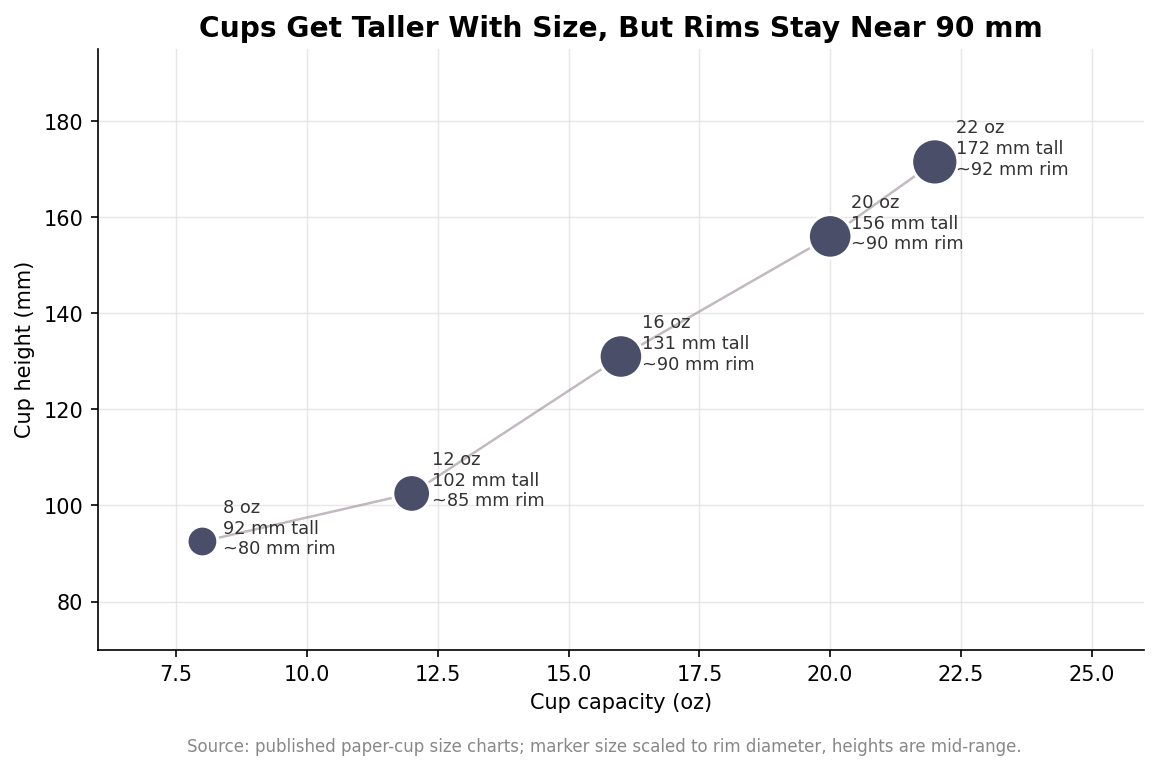
That shared rim is why one carrier can span several cup sizes. Because a 12, 16, 20, and 22-ounce cup all present a rim in the 90 mm neighborhood, a single carrier opening grips all of them at nearly the same point. The height, not the width, is what changes, and height affects stability rather than fit. It is also worth remembering that a cup’s usable fill is about 10 to 15 percent below its nominal size to leave headroom, so a 12-ounce cup pours closer to 10 ounces; that matters for pricing drinks, not for fit, but it surprises people who assume the number on the cup is the liquid inside.
The carrier formats and what they hold
Molded-fiber carriers come in a few standard formats, and each is built around a cup-size band rather than a single size. A standard 2-cup carrier typically handles cups from about 8 to 24 ounces, which covers nearly every everyday hot and cold drink. A standard 4-cup carrier usually stretches a little further, roughly 8 to 32 ounces, so it takes the larger iced drinks that a smaller tray cannot. For oversized cups there is a large-tray format: one common molded-fiber 2-cup tray is rated for 24 to 44-ounce cups with a pedestal base, with a maximum cup-bottom diameter of about 3.5 inches, and the whole tray measures roughly 15 by 11.25 by 2 inches. The chart below lines up the fit ranges.
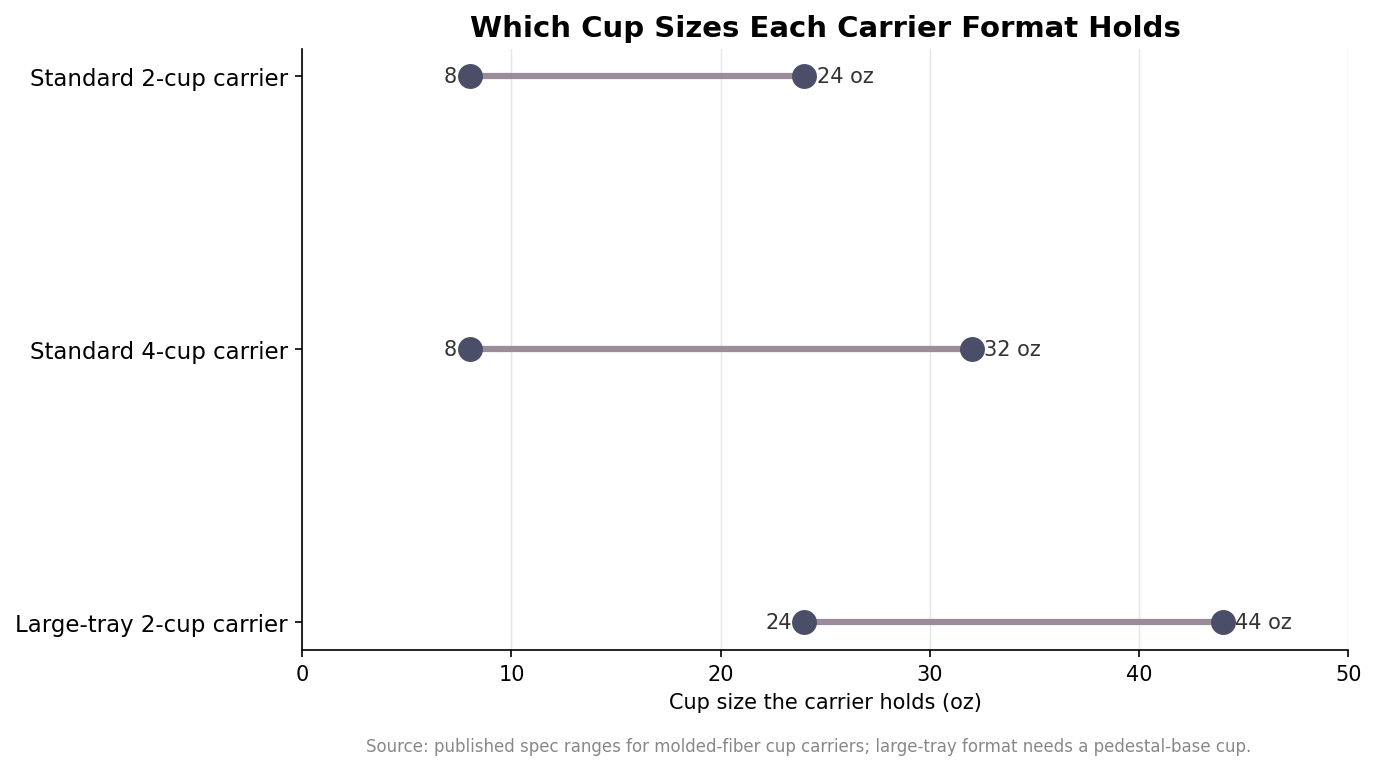
The practical reading is that the two-cup and four-cup standards overlap heavily and together cover the ordinary menu, while the large tray is a specialist item for smoothie and mega-size cups. Mixing sizes in one carrier works as long as every cup falls inside the tray’s rated band; a carrier holding an 8-ounce espresso next to a 24-ounce iced tea is fine, but only because both sit within the 8-to-24 range. Push one cup outside the band and it either will not seat or will sit loose.
Material and why it affects fit
Most of these carriers are molded fiber, frequently made from 100 percent recycled content, and the material choice is not just an environmental preference; it changes how the carrier behaves. Molded pulp has a bit of give, so it grips a cup wall with light friction and tolerates small variations between cup brands. Paperboard carriers, by contrast, hold cups in die-cut openings and are less forgiving of a cup that runs a millimeter off the expected rim. Neither is better in the abstract, but if your cups come from more than one supplier, the slight flex of molded fiber absorbs the inconsistency better than a rigid cutout. This is the same reason it pays to test a carrier with your actual cups before committing to a large run rather than trusting the ounce rating alone.
Matching the carrier to your drinks
Start from the largest cup on your menu and work down. If your biggest drink is a 24-ounce iced coffee, a standard 2-cup or 4-cup carrier covers everything you serve, and you never need the large tray. If you sell 32-ounce smoothies or 44-ounce fountain drinks, the standard carriers will not hold them, and you need the large-tray format for those orders while keeping a standard carrier for regular drinks. Very small cups are the opposite trap: an 8-ounce cup sits at the bottom edge of the standard range, so confirm it seats snugly rather than assuming it will, especially in a 4-cup tray built to also accept 32-ounce cups.
Height is the stability factor to watch. Two carriers can share the same rim-based fit yet behave differently once the drinks are in, because a pair of 22-ounce cups standing 170 mm tall raises the center of gravity far more than short 8-ounce cups. For tall-cup orders, a carrier with a deeper cradle or a tray base adds meaningful tip resistance, which matters most for delivery and drive-thru handoffs where the carrier gets carried one-handed. If most of your volume is large iced drinks, prioritize a format that grips the cup lower and gives a stable base, not just one that technically fits the rim.
The whole decision comes down to three numbers: your largest cup, your smallest cup, and how tall the big ones stand. Pick the carrier band that brackets your full cup range, favor molded fiber if your cups come from mixed suppliers, and reserve the large tray for genuinely oversized drinks. Do that and the carrier stops being the weak link between the counter and the car.
Leave a Reply