Category: Uncategorized

  • What Cup Sizes Fit Which Carrier: A Drink Carrier Spec Comparison

    What Cup Sizes Fit Which Carrier: A Drink Carrier Spec Comparison

    The most common cup carrier complaint is not about print quality or price; it is that the carrier and the cup did not match. A tray rated for regular coffee cups will not hold a 32-ounce iced drink, and a carrier sized for large cups lets a small 8-ounce cup rattle loose. Because a molded-fiber carrier grips the cup near its upper wall, fit is a genuine spec, not a guess, and getting it right starts with understanding how cup dimensions actually change across sizes. This is a straight comparison of cup sizes, carrier formats, and which combinations hold together on a real counter.

    How cup dimensions change with size

    The counterintuitive part of cup sizing is that as cups get bigger, they get much taller but barely get wider at the rim. An 8-ounce cup has a top diameter around 80 mm and stands roughly 90 to 95 mm tall. Step up to 12 ounces and the rim is about 80 to 90 mm depending on the maker, with height near 100 to 105 mm. From 16 ounces upward, most cups settle on a shared 90 mm rim, while height keeps climbing: about 127 to 135 mm at 16 ounces, 152 to 160 mm at 20 ounces, and 165 to 178 mm at 22 ounces. The chart below shows the pattern.
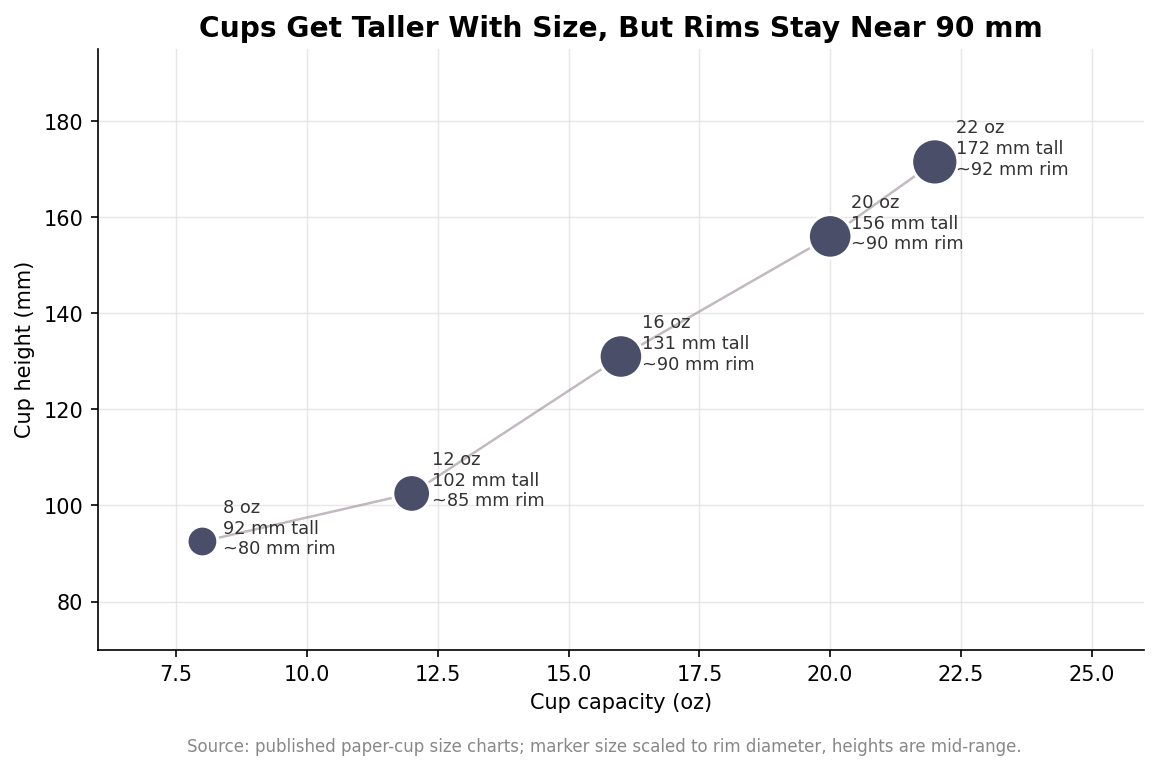
    Scatter chart of paper cup capacity versus height showing cups grow taller with size while rim diameter stays near 90 mm
    Cup height rises steeply with size while the rim stays close to 90 mm across most sizes.

    That shared rim is why one carrier can span several cup sizes. Because a 12, 16, 20, and 22-ounce cup all present a rim in the 90 mm neighborhood, a single carrier opening grips all of them at nearly the same point. The height, not the width, is what changes, and height affects stability rather than fit. It is also worth remembering that a cup’s usable fill is about 10 to 15 percent below its nominal size to leave headroom, so a 12-ounce cup pours closer to 10 ounces; that matters for pricing drinks, not for fit, but it surprises people who assume the number on the cup is the liquid inside.

    The carrier formats and what they hold

    Molded-fiber carriers come in a few standard formats, and each is built around a cup-size band rather than a single size. A standard 2-cup carrier typically handles cups from about 8 to 24 ounces, which covers nearly every everyday hot and cold drink. A standard 4-cup carrier usually stretches a little further, roughly 8 to 32 ounces, so it takes the larger iced drinks that a smaller tray cannot. For oversized cups there is a large-tray format: one common molded-fiber 2-cup tray is rated for 24 to 44-ounce cups with a pedestal base, with a maximum cup-bottom diameter of about 3.5 inches, and the whole tray measures roughly 15 by 11.25 by 2 inches. The chart below lines up the fit ranges.
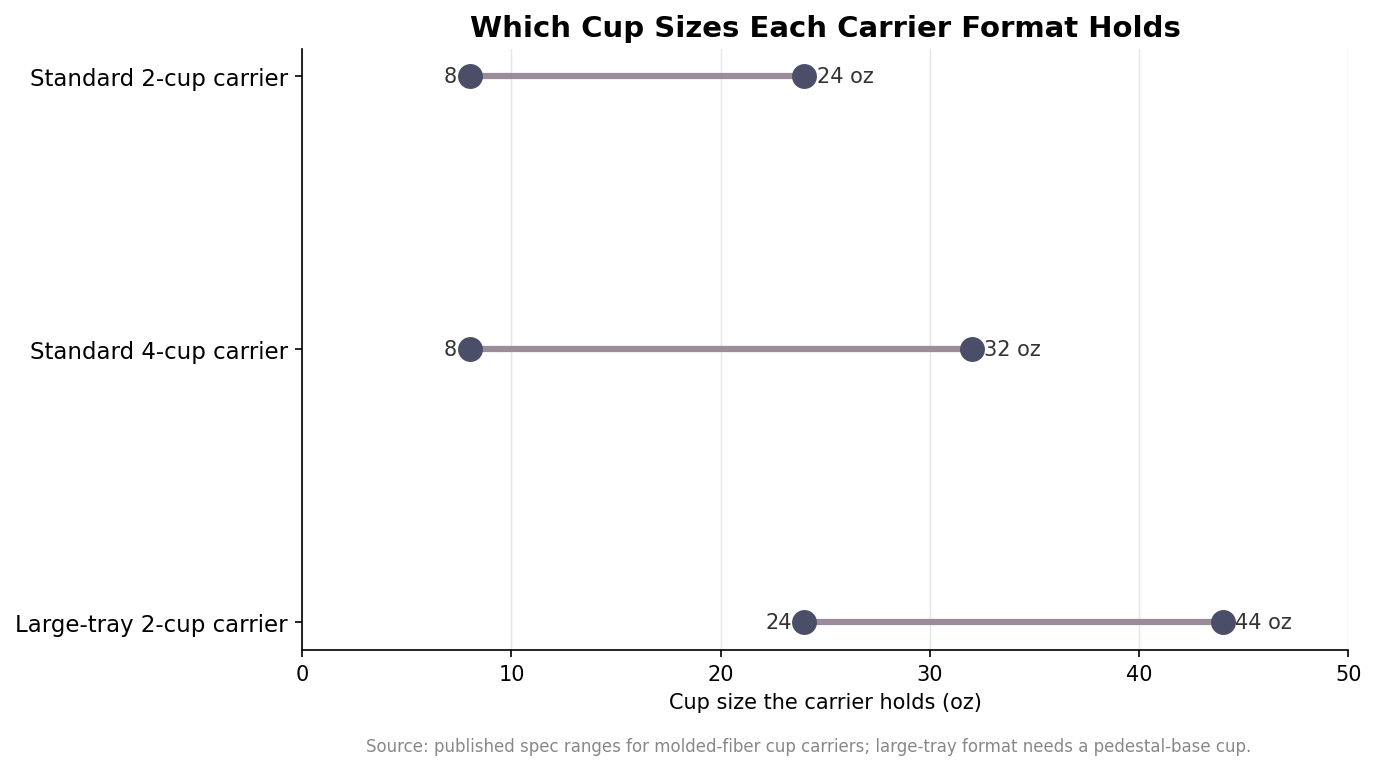
    Range chart showing the ounce range each cup carrier format holds: standard 2-cup 8 to 24 oz, 4-cup 8 to 32 oz, large-tray 24 to 44 oz
    Cup-size bands for standard and large-tray molded-fiber carriers.

    The practical reading is that the two-cup and four-cup standards overlap heavily and together cover the ordinary menu, while the large tray is a specialist item for smoothie and mega-size cups. Mixing sizes in one carrier works as long as every cup falls inside the tray’s rated band; a carrier holding an 8-ounce espresso next to a 24-ounce iced tea is fine, but only because both sit within the 8-to-24 range. Push one cup outside the band and it either will not seat or will sit loose.

    Material and why it affects fit

    Most of these carriers are molded fiber, frequently made from 100 percent recycled content, and the material choice is not just an environmental preference; it changes how the carrier behaves. Molded pulp has a bit of give, so it grips a cup wall with light friction and tolerates small variations between cup brands. Paperboard carriers, by contrast, hold cups in die-cut openings and are less forgiving of a cup that runs a millimeter off the expected rim. Neither is better in the abstract, but if your cups come from more than one supplier, the slight flex of molded fiber absorbs the inconsistency better than a rigid cutout. This is the same reason it pays to test a carrier with your actual cups before committing to a large run rather than trusting the ounce rating alone.

    Matching the carrier to your drinks

    Start from the largest cup on your menu and work down. If your biggest drink is a 24-ounce iced coffee, a standard 2-cup or 4-cup carrier covers everything you serve, and you never need the large tray. If you sell 32-ounce smoothies or 44-ounce fountain drinks, the standard carriers will not hold them, and you need the large-tray format for those orders while keeping a standard carrier for regular drinks. Very small cups are the opposite trap: an 8-ounce cup sits at the bottom edge of the standard range, so confirm it seats snugly rather than assuming it will, especially in a 4-cup tray built to also accept 32-ounce cups.

    Height is the stability factor to watch. Two carriers can share the same rim-based fit yet behave differently once the drinks are in, because a pair of 22-ounce cups standing 170 mm tall raises the center of gravity far more than short 8-ounce cups. For tall-cup orders, a carrier with a deeper cradle or a tray base adds meaningful tip resistance, which matters most for delivery and drive-thru handoffs where the carrier gets carried one-handed. If most of your volume is large iced drinks, prioritize a format that grips the cup lower and gives a stable base, not just one that technically fits the rim.

    The whole decision comes down to three numbers: your largest cup, your smallest cup, and how tall the big ones stand. Pick the carrier band that brackets your full cup range, favor molded fiber if your cups come from mixed suppliers, and reserve the large tray for genuinely oversized drinks. Do that and the carrier stops being the weak link between the counter and the car.
  • 5 Mistakes to Avoid When Ordering Custom Cup Carriers

    5 Mistakes to Avoid When Ordering Custom Cup Carriers

    A cup carrier only has one job, which is to get full drinks to a car or a doorstep without a spill, and it is surprisingly easy to buy one that cannot do it. Most ordering mistakes trace back to the same root cause: treating the carrier as a generic accessory rather than a part that has to fit specific cups, survive specific conditions and carry your brand at the same time. The errors below are the ones that lead to reorders, spilled drinks and wasted print budgets, and every one of them is avoidable with a few minutes of checking before the order goes in.

    Mistake 1: Speccing by ounce size instead of rim and base

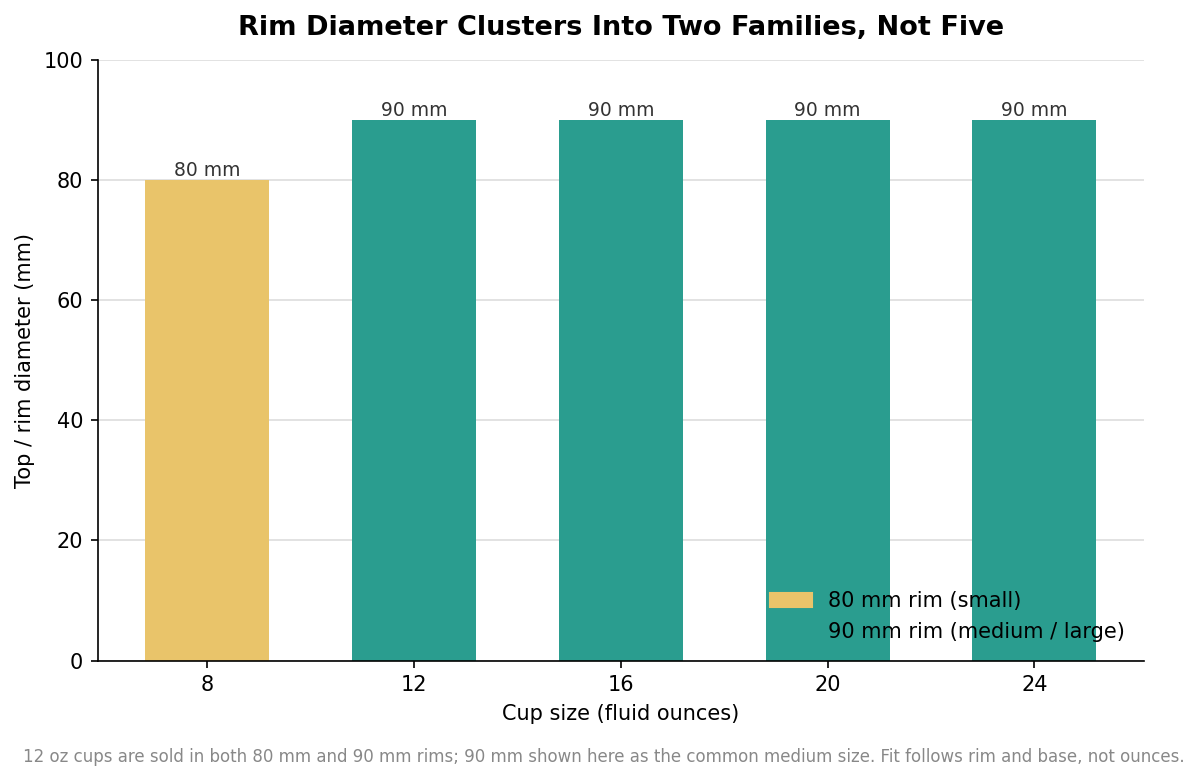
    Ounces do not determine fit; the cup’s geometry does. Buyers routinely order a “16 oz carrier” and assume any 16 oz cup will seat in it, but a carrier grips a cup by its rim and its base, not its volume. Disposable cups actually cluster into just two rim families rather than a unique size for every ounce count: smaller cups tend to use an eighty-millimeter rim while most medium and large cups share a ninety-millimeter rim. That means a 12 oz and a 20 oz cup can share the same opening while two different 12 oz cups from different brands do not. Molded pulp carriers that cradle the lower cup often accommodate a wide span of sizes, which is why you see a single tray rated for anything from roughly eight up to forty-plus ounces, whereas paperboard trays with die-cut holes are matched to a narrower rim range. Before ordering, confirm the actual rim and base diameters of the cups you serve, not just their advertised volume.

    Bar chart of cup rim diameter by size showing an 80mm small family and a 90mm medium and large family
    Cups fit into two rim families, so a carrier is matched by rim and base rather than by ounces.

    Mistake 2: Forgetting height and the center of gravity

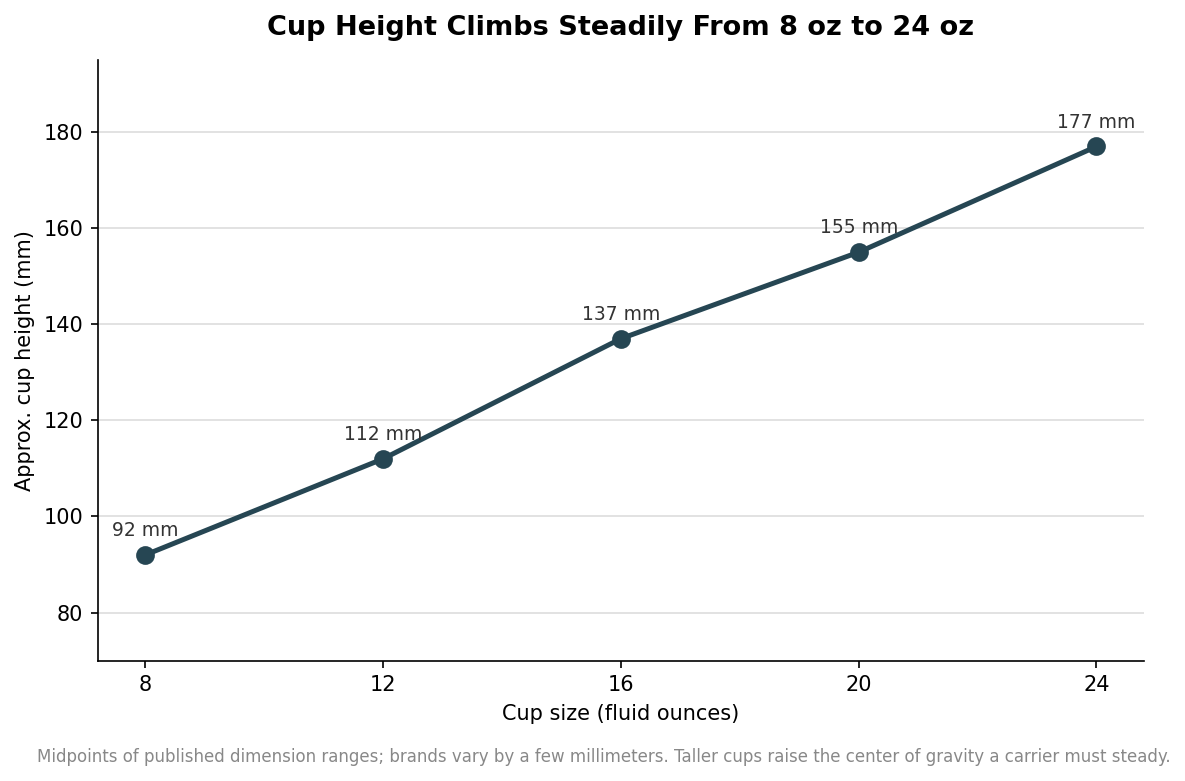
    A carrier that grips well can still deliver a tipped drink. As cups scale up in volume they grow much taller, from around ninety millimeters at 8 oz to well over one hundred and seventy at 24 oz, and that added height lifts the center of gravity the carrier has to steady. A tray that feels stable with short cups can let tall ones sway and topple, especially when they are only partly filled or capped with a tall domed lid. If your menu skews toward large iced drinks, choose a carrier with deeper cup wells or a higher collar that holds the cup lower down its body, and test it with your tallest cup and lid combination rather than a mid-size sample.

    Line chart showing disposable cup height in millimeters rising from 8oz to 24oz
    Taller large cups raise the center of gravity a carrier has to keep steady.

    Mistake 3: Choosing the wrong material for the conditions

    Moisture is the enemy, and not every board fights it equally. Molded pulp fiber handles heat and dampness well and keeps its grip when a hot cup sweats or a lid drips, which is why it dominates cafe and drive-through use. Uncoated or lightweight paperboard can soften as it absorbs condensation from iced drinks or steam from hot ones, and a carrier that goes limp mid-transport is worse than no carrier at all. Cold-drink programs are especially unforgiving because condensation runs down the cup and pools in the tray, so match the material to the drink: prioritize wet strength for iced and hot beverages, and do not assume a stiff, dry sample tells you how the tray behaves once real drinks start weeping into it.

    Mistake 4: Ordering the wrong capacity mix

    The default four-cup tray is not always the right one. Carriers come mainly in two- and four-cup configurations, and buyers often standardize on the four-cup unit because it seems more versatile. The catch is that a four-cup tray carrying a single drink is unstable, because the lone cup sits off-center with nothing to brace against, and it also wastes material and counter space on every one- and two-drink order. If most of your tickets are one or two beverages, a two-cup carrier will be steadier and cheaper for the bulk of your volume, with four-cup trays kept on hand for the larger orders. Look at your actual order mix before you commit to a single format, and consider stocking both rather than forcing every order into one size.

    Mistake 5: Treating branding as an afterthought

    The surface you print on decides how good your logo looks. A cup carrier is prime brand real estate that a customer carries through a parking lot and holds at a doorstep, but the two common materials print very differently. Molded pulp has a textured, curved, absorbent surface that suits simple one- or two-color marks and soft, earthy branding, while it struggles with fine detail and crisp edges. Paperboard offers a smoother, flatter face that holds sharper, more colorful printing, so if a detailed full-color logo is central to your brand, factor that into the material choice rather than discovering the limitation after the proof. Custom printing also carries its own minimum order quantities and lead times that run longer than buying blank stock, so build that runway into your timeline, and design within the tray’s real print area instead of assuming a mockup’s flat artboard will wrap cleanly onto a molded, contoured surface.

    None of these mistakes are exotic, which is exactly why they are so common. Confirm the rim and base of the cups you actually serve, account for the height of your tallest drink, match the material to the moisture it will face, size the capacity to your real order mix, and choose the material with your branding in mind. Run through those five checks before you approve a custom cup carrier order and the tray will do its one job every time, which is the only performance metric your customers will ever notice.

  • Compostable or Recyclable? A Cup Carrier Compliance Guide

    Compostable or Recyclable? A Cup Carrier Compliance Guide

    A cup carrier is a small thing to agonize over, until a customer photographs your logo on a tray and asks whether it is actually compostable, or your city passes a packaging ordinance and your supplier’s stock no longer qualifies. The words printed on foodservice packaging—compostable, recyclable, biodegradable, plant-based—are not interchangeable, and they carry real regulatory and reputational weight. If you are branding carriers for a cafe, a catering operation, or a delivery program, it pays to know exactly what those claims mean and which certifications stand behind them before you commit to a print run.

    Compostable, recyclable, biodegradable: three different promises

    Biodegradable is the weakest and least regulated of the three. It only means the material will eventually break down through natural processes, with no promise about how long that takes or what it leaves behind. On its own it is close to meaningless as a purchasing criterion. Compostable is a stricter, testable claim: the material must break down into non-toxic components within a defined time under defined conditions, and legitimate compostable products are certified to a specific standard. Recyclable means the material can be reprocessed into new product—but only if a facility that accepts it exists and the item reaches that facility clean. A carrier can honestly be all three, one, or none, and the differences matter the moment someone tries to actually dispose of it.

    The certifications that back a compostable claim

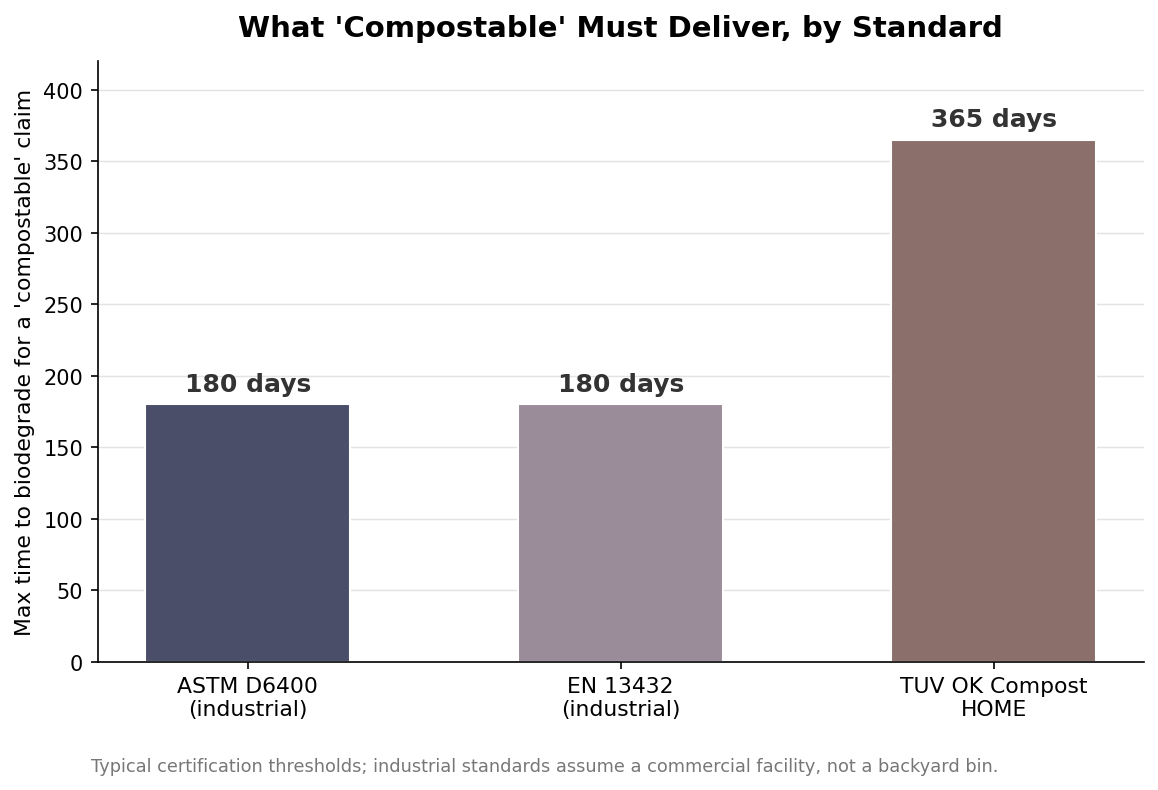
    When a molded fiber carrier is marketed as compostable, look for the standard it is certified to rather than the adjective alone. In North America the key reference is ASTM D6400 for compostable materials, with ASTM D6868 covering fiber products with compostable coatings; in Europe the equivalent is EN 13432. Certification marks such as TUV OK Compost, CMA, and BPI verify that a product actually meets one of these standards through independent testing. The standards define not just whether a product breaks down but how fast it must do so to earn the claim.

    Bar chart of maximum biodegradation time for a compostable claim: ASTM D6400 and EN 13432 industrial at 180 days, TUV OK Compost HOME at 365 days
    Certification standards cap how long a carrier can take to break down before it may be called compostable.

    The critical distinction hiding in these numbers is industrial versus home. Industrial standards assume a commercial composting facility that reaches high, sustained temperatures; a home-compost certification like TUV OK Compost HOME allows a longer window precisely because a backyard bin runs cooler. A carrier certified only for industrial composting is genuinely compostable, but only where a commercial facility accepts it—which is why reputable products carry a caveat that such facilities may not exist in your area. Certification tells you what the material can do; local infrastructure decides what actually happens to it.

    Recyclable in theory, contaminated in practice

    Molded pulp carriers are made largely from recycled paper fiber, so on paper they slot neatly into the paper recycling stream. In practice, two things get in the way. First, food and liquid contamination: a carrier soaked in spilled coffee is often rejected by recyclers who cannot process wet, soiled fiber, even though the clean version would be accepted. Second, coatings: a paperboard carrier lined with plastic to resist moisture is far harder to recycle than uncoated molded fiber, because the lining has to be separated out. The upshot is that an uncoated molded fiber carrier is frequently better sent to compost than to the recycling bin, while a plastic-lined paperboard one may not be cleanly recyclable at all. Match the disposal claim to the reality of how the item leaves a customer’s hands—usually dirty.

    PFAS and coatings: the fine print buyers miss

    For years, fiber foodservice packaging often relied on PFAS—per- and polyfluoroalkyl substances—for grease and moisture resistance. Those “forever chemicals” have become a regulatory flashpoint, and a growing number of U.S. states now restrict intentionally added PFAS in foodservice packaging. This is the single compliance issue most likely to catch a buyer off guard, because a carrier can be certified compostable and still be a problem if it contains added PFAS. When you source carriers, look explicitly for a no added PFAS declaration, and treat it as a baseline requirement rather than a premium feature. Uncoated molded fiber generally sidesteps the issue; anything with a moisture barrier deserves a direct question about what that barrier is made of.

    How the options really compare at end of life

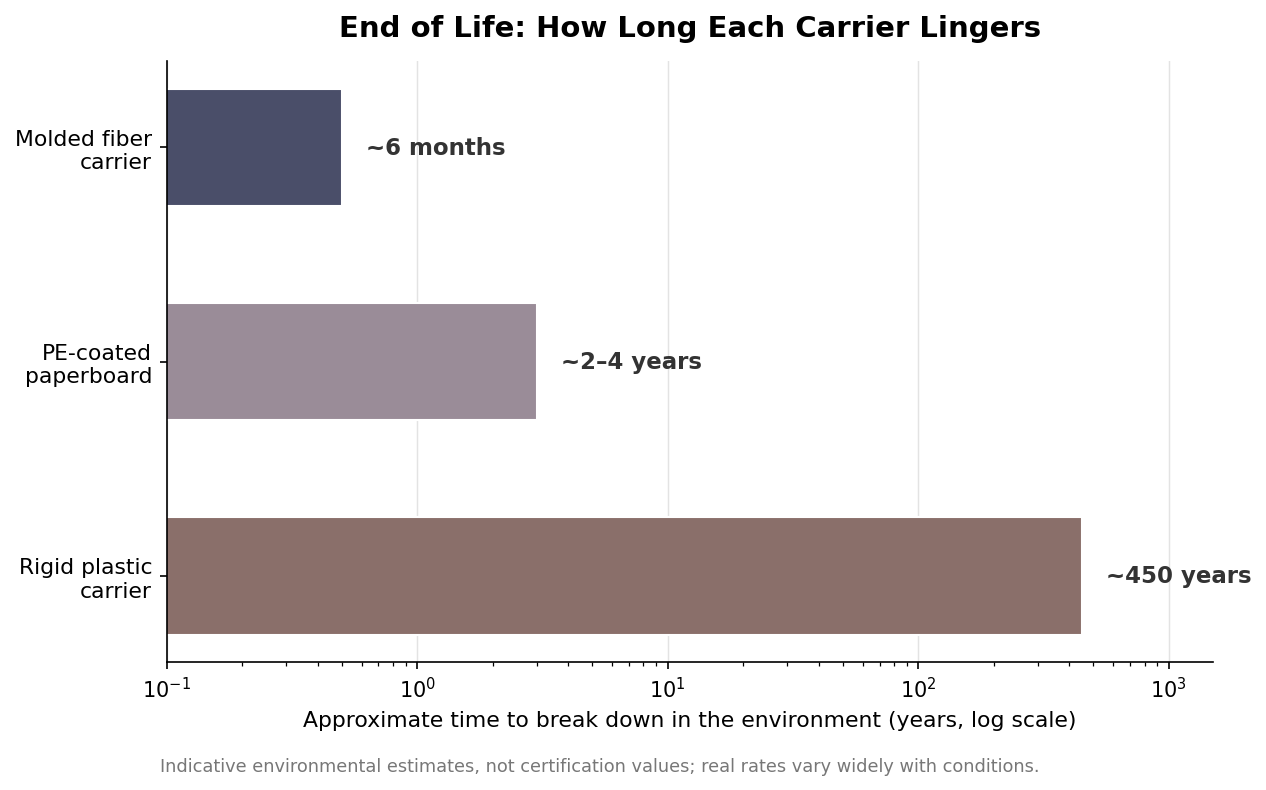
    Step back from the certifications and the environmental picture is stark. Uncoated molded fiber breaks down on a timescale of months, coated paperboard takes materially longer because of its lining, and rigid plastic carriers persist for centuries. The exact figures depend heavily on real-world conditions and should be read as indicative rather than precise, but the order of magnitude is not in dispute.

    Log-scale bar chart of approximate environmental breakdown time: molded fiber carrier about 6 months, PE-coated paperboard 2 to 4 years, rigid plastic carrier about 450 years
    Order of magnitude at end of life: molded fiber breaks down in months where plastic persists for centuries.

    This is the comparison worth putting in front of a sustainability-minded customer, with the honest caveat that a compostable carrier only delivers its benefit if it reaches a composter. A certified-compostable tray that ends up in a landfill still beats plastic on its material footprint, but it will not compost in an anaerobic landfill the way it would in a managed facility. The environmental win is real, but it is conditional on where your waste actually goes.

    Specifying a carrier that matches your waste stream

    Pull the decision together around your local reality, not just the label. Decide whether your operation and your customers realistically have access to commercial composting, curbside fiber recycling, or neither, and choose accordingly: certified-compostable uncoated molded fiber where composting exists, clean recyclable fiber where recycling is the realistic path, and a no-added-PFAS declaration in every case. Ask your supplier for the specific certification standard and the composting conditions it assumes, confirm the cup-size range the carrier fits so it works across your menu, and keep any recyclability or compostability messaging you print on the carrier accurate to what a customer can actually do with it. Overclaiming on packaging is both a compliance risk and a trust risk; a modest, accurate claim backed by a real certification is worth far more than a bold one that falls apart under a second look.

  • How Many Cup Carriers Should You Order?

    Call or Text us: (929) 605-4397

    How Many Cup Carriers Should You Order?

    Most cafes burn through far more cup carriers than they expect, and running out mid-rush means loose cups, spilled drinks, and a counter line that stops moving. Here is the simple math for sizing your first custom order, plus the reorder rhythm that keeps unit costs down.

    Start with your multi-drink ticket count

    Carriers are not used on every order — only on tickets with two or more drinks to go. Pull a normal week from your POS and count the to-go tickets with 2+ drinks. That weekly number, times 1.15 for waste and double-carrying, is your true weekly burn.

    The order-size sweet spot

    Custom-printed carriers price in tiers, and the jump from a small run to a mid run usually cuts the per-unit cost by 20–35%. As a rule of thumb:

    Weekly burnRecommended first orderCoverage
    Under 1502,000~3 months
    150–4005,000~3–4 months
    400–1,00010,000~4 months
    Over 1,00015,000+quarterly reorder

    Three to four months of stock is the sweet spot: deep enough into the price tiers to matter, small enough that storage stays manageable and your artwork can still evolve.

    Do not forget storage and seasonality

    Flat-packed paperboard carriers store compactly — a case of 500 is about the size of two shoe boxes — but molded pulp trays are bulkier, so cap pulp orders at what your back room actually fits. If you run an iced-drink summer spike or a holiday latte season, time the big order to land four to six weeks before it starts.

    Reorder before you think you need to

    Custom printing has a production and shipping lead time of about two weeks. Set a reorder trigger at six weeks of remaining stock and you will never be forced to bridge the gap with plain stock carriers that waste the branding you paid for.

    Design your custom cup carriers

    Tell us your cup sizes, volume, and artwork and we will spec the material, capacity, and printing that fit your cafe or concession.

    Get a Quote

    Home · About · Blog

    GET A QUOTE
  • Molded Pulp vs. Paperboard Cup Carriers: Which Fits Your Counter?

    Call or Text us: (929) 605-4397

    Molded Pulp vs. Paperboard Cup Carriers: Which Fits Your Counter?

    Pulp trays and paperboard carriers both get four drinks out the door, but they behave very differently on a busy counter, in storage, and on your brand. Here is how to pick the right one for your cafe, concession stand, or catering run.

    How they differ

    Molded pulp trays are pressed from recycled fiber into a rigid tray with deep cup wells. Paperboard carriers fold flat and pop open, with die-cut holes or a clip design that grips the cup sleeve. Both hold standard 8–24 oz cups; the differences are rigidity, storage, and print quality.

    Where pulp wins

    Pulp is the stability king. The deep wells cradle heavy iced drinks and open-lid cups, which makes pulp the safe pick for delivery orders, drive-through windows, and stadium concessions where carriers get carried far and set down hard. It also reads as eco-friendly at a glance, which matters to many customers.

    Where paperboard wins

    Paperboard wins on branding and back-room space. The flat surfaces take full-color print beautifully — logo, pattern, social handle, a QR code — while pulp is limited to a one-color stamp or a printed label. A case of flat paperboard carriers takes roughly a quarter of the shelf space of the same count in pulp trays, and the per-unit cost is usually lower at every volume tier.

    The quick decision guide

    Your situationPick
    Delivery-heavy, long carries, iced drinksMolded pulp
    Brand visibility is the goalPrinted paperboard
    Tight storage spacePaperboard
    Catering drop-offs of 6–8 drinksPulp catering tray

    Plenty of shops run both: printed paperboard for the counter rush, pulp trays for delivery platforms and catering. Because both are custom-printed against the same artwork, your brand stays consistent either way.

    Design your custom cup carriers

    Tell us your cup sizes, volume, and artwork and we will spec the material, capacity, and printing that fit your cafe or concession.

    Get a Quote

    Home · About · Blog

    GET A QUOTE