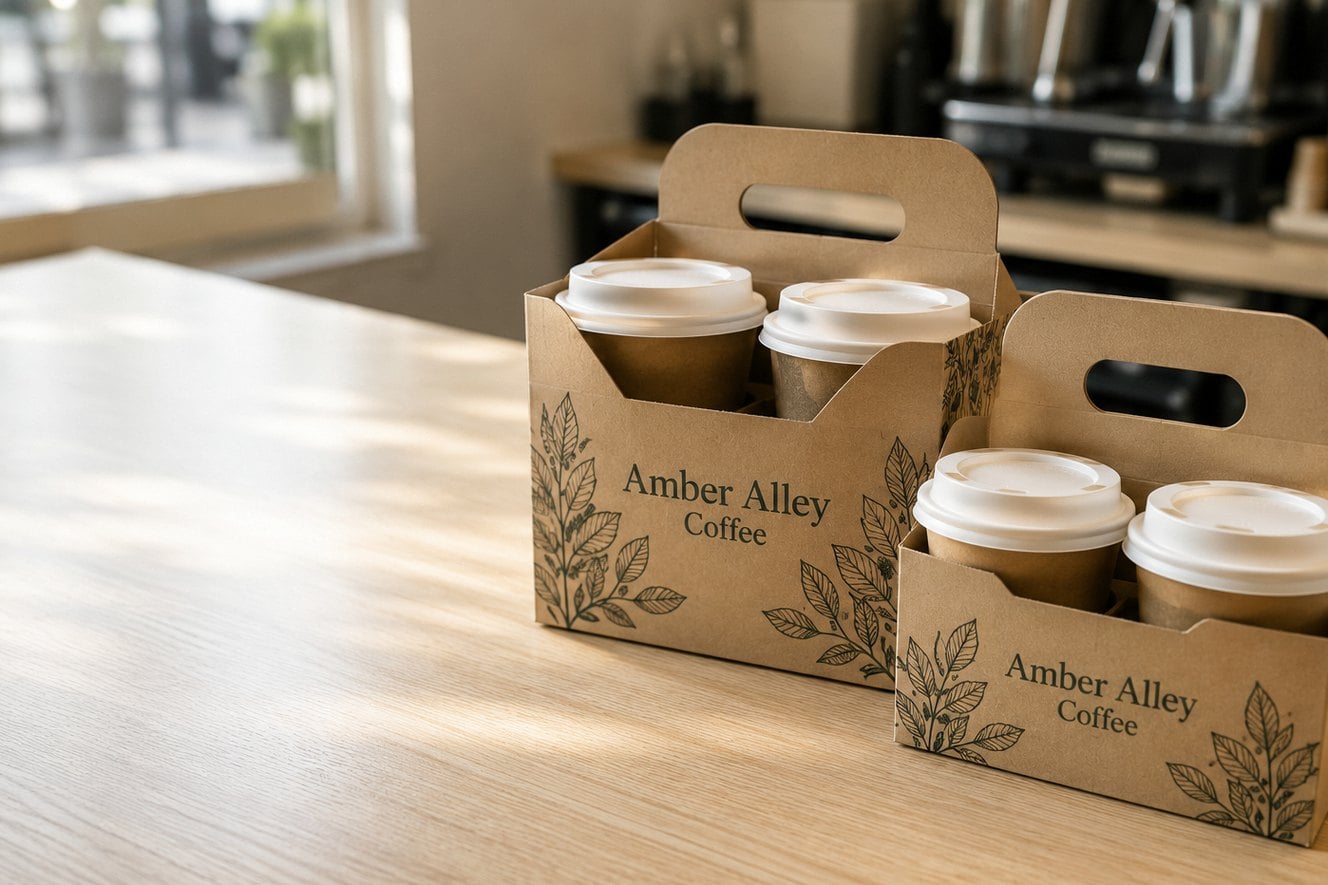
Coffee shops get the most from custom cup carriers by matching a style to each service moment: a two-cup or four-cup carrier for the counter and drive-thru, molded pulp for iced drinks, and a catering tray for office runs. Custom Cup Carriers prints your logo on all of them, starting at 12 carriers, with a free mockup within 24 hours.
- Minimum order is 12 cup carriers
- Free digital mockup within 24 hours, unlimited free revisions
- Standard turnaround about 2 weeks, faster with express shipping
- Pay nothing until you approve the design
- Six styles, from two-cup clip carriers to eight-cup catering trays
Why do coffee shops order custom cup carriers instead of plain ones?
Coffee shops order custom cup carriers because the carrier is the one piece of packaging that leaves the counter, rides in a car, and lands on an office desk with every multi-drink order. A plain tray does the job of holding cups; a printed tray also tells everyone in the meeting where the drinks came from.
For an independent cafe, that matters more than it does for a chain. Your cup sleeve might be covered by a hand, and your bag might be tossed in the car, but the cup carriers sit in the middle of the table while the drinks get passed around. A clear logo, your neighborhood name, or a short line like “order ahead online” turns that moment into a reminder to come back.
Custom cup carriers also make a shop look organized at the handoff shelf. When mobile orders, delivery-app pickups and walk-in group orders all use the same branded trays, staff can spot finished orders faster and customers can see which order is theirs.
Which cup carrier style fits each part of a coffee shop's service?
The right cup carriers for a coffee shop depend on how the drinks leave the building. Most cafes end up with two styles: a small carrier for the everyday pair of lattes, and a larger tray or caddy for office runs and catering. The table below maps each style on Custom Cup Carriers to the service moment it handles best.
| Carrier style | Best coffee shop use | Why it works |
|---|---|---|
| Two-cup clip carrier | Couples, commuters, the second drink for a coworker | Compact, quick to load, and the logo panel sits right at eye level |
| Four-cup paperboard carrier | Drive-thru, mobile pickup, small team orders | Flat-stores behind the bar and prints crisply on the paperboard face |
| Molded pulp drink tray | Iced drinks and tall cups that sweat | Deep pockets hold cups steady and the fiber handles condensation |
| Handled cup caddy | Walking orders and delivery drivers | A carry handle frees one hand for the door or a pastry bag |
| Eight-cup catering tray | Office coffee runs and meeting orders | One branded tray replaces a stack of small carriers |
| Cup and snack combo tray | Drink-and-pastry combos, breakfast specials | Holds a cup and a muffin or croissant together |
If you only stock one style, a four-cup paperboard carrier covers the widest range of everyday orders.
What should a coffee shop print on its cup carriers?
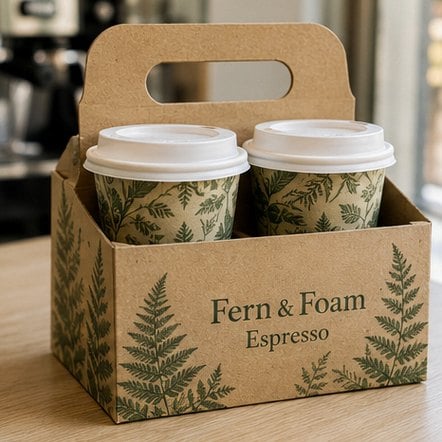
A coffee shop should print the shop name or logo first, then one short call to action, and nothing more. Cup carriers are read in a glance, usually from across a table, so a bold mark and a few words outperform a busy layout every time.
Good second lines for a cafe carrier include:
- Your web address or the name of your ordering app
- An Instagram handle, so customers can tag the shop
- A neighborhood or street name that makes the shop feel local
- A line about catering, such as “we cater meetings”, aimed at the office crowd receiving the tray
Skip anything that will go out of date fast, such as a seasonal drink name or this month’s hours. Cup carriers sit in the back room for weeks, and a timeless design means every carrier in the box stays usable.
Color matters too. Most cafes match the carrier print to their cup sleeves or menu board so the order reads as one brand. The free mockup from Custom Cup Carriers, returned within 24 hours, shows exactly how your logo sits on the carrier before anything is printed.
How do cup carriers handle iced drinks, hot drinks and mixed orders?
Cup carriers handle mixed coffee shop orders best when the style matches the heaviest, wettest drink in the order. A hot latte in a paper cup is easy for any carrier; a tall iced cold brew sweating condensation is the real test.
For shops that sell a lot of iced drinks, a molded pulp drink tray is usually the safer choice. The deep molded pockets cradle tall cups, and the fiber is built to deal with moisture during a normal trip home or to the office. Paperboard carriers work very well for hot drinks and quick trips, and they print with sharper detail, which is why many cafes use paperboard for hot orders and pulp for iced ones.
Tips for mixed orders at the handoff shelf
- Seat the tallest, heaviest cup in a corner pocket, not the middle, so the carrier stays level.
- Leave an empty pocket next to an iced drink when possible to keep condensation off hot cups.
- Use a handled cup caddy for delivery drivers who need to carry trays up stairs or through doors.
If you are unsure which style suits your cup sizes, ask Custom Cup Carriers to confirm fit with your quote request before the mockup is made.
How many cup carriers does a coffee shop need on hand?
A coffee shop needs enough cup carriers to cover its multi-drink orders until the next reorder can arrive, plus a cushion for busy mornings. The minimum order at Custom Cup Carriers is 12 carriers, which is useful for testing a new style or a seasonal design before committing to a full run.
To size a regular order, look at your own point-of-sale data rather than a rule of thumb. Count how many tickets in a typical week include two or more drinks, separate the drive-thru and mobile orders from the walk-ins, and note your catering and office orders on their own. Each of those groups usually maps to a different carrier style.
- Pull a normal week of tickets with multiple drinks.
- Split them by carrier style: two-cup, four-cup, and catering-size.
- Multiply by the number of weeks you want between reorders.
- Add a buffer for holidays, local events and rainy-day delivery spikes.
- Set a reorder point at the stock level that still covers about two weeks of use.
Because standard turnaround is about 2 weeks, reordering when you still have around a fortnight of carriers left keeps the handoff shelf stocked without overfilling the storeroom.
How does a coffee shop order custom cup carriers from Custom Cup Carriers?
A coffee shop orders custom cup carriers by sending a quote request with the carrier style, the quantity and the logo, then approving a free digital mockup. The full process is laid out on the how it works page, and the short version looks like this:
- Submit the custom quote form with your preferred style and quantity.
- Upload your logo in whatever format you have; the design team cleans it up if needed.
- Review the free mockup, delivered within 24 hours.
- Request changes as many times as you like; revisions are unlimited and free.
- Approve the design. You pay nothing until you approve it.
- Receive your carriers in about 2 weeks, or faster with express shipping.
Shops that plan to use more than one style can request mockups for several carriers in the same quote, which makes it easy to keep the logo size and colors consistent across the counter, the drive-thru and the catering menu.
What drives the cost of custom cup carriers for a cafe?
The cost of custom cup carriers for a cafe is driven by the carrier style, the material, the number of print colors, and the order quantity. Custom Cup Carriers does not publish a one-size price because those factors change from shop to shop, so the quote form returns a number based on your actual order.
- Style and size: a two-cup clip carrier uses less material than an eight-cup catering tray.
- Material: paperboard and molded pulp are made differently and are priced differently.
- Print complexity: a one-color logo is simpler to produce than full-coverage artwork.
- Quantity: larger runs spread setup work across more carriers.
- Timing: express shipping adds speed when an opening date or event is close.
The quickest way to compare options is to request quotes on two styles at once, such as paperboard for hot drinks and molded pulp for iced drinks, and decide with real numbers in hand.
Frequently asked questions
Can a coffee shop use different designs on its two-cup and four-cup carriers?
Coffee shop cup carriers can carry a different design on each style. Many cafes keep the same logo but adjust the layout, using a simple mark on the small two-cup clip carrier and a fuller design on the four-cup tray. Custom Cup Carriers can mock up each style in the same quote so the colors and logo size stay consistent across the counter.
Are custom cup carriers a good fit for drive-thru coffee windows?
Custom cup carriers are a strong fit for drive-thru windows because a flat-stored paperboard carrier can be popped open and loaded in seconds. The printed logo faces the driver as the order is passed through the window, which keeps the shop's brand in the car. Many drive-thru operators pair a two-cup and a four-cup style to cover most orders.
Which cup carrier works best for large iced coffee drinks?
The molded pulp drink tray is usually the best cup carrier for large iced coffee drinks. Its deep molded pockets hold tall cups steady, and the fiber is made to cope with condensation during an ordinary trip. Custom Cup Carriers can confirm fit with your specific iced cup size when you send a quote request, before the free mockup is created.
Can a cafe add a QR code or ordering link to its cup carriers?
Cafe cup carriers can include a QR code or a short web address next to the logo. A QR code that links to your online ordering page or loyalty sign-up gives the people receiving an office coffee run an easy way to order next time. Keep the code large, place it on a flat panel, and check it on the mockup before approving.
Do delivery orders from coffee shops need a different cup carrier?
Delivery orders from coffee shops often travel better in a handled cup caddy or a molded pulp tray than in a basic clip carrier. Drivers carry trays through doors, up stairs and across parking lots, so a handle and deep pockets reduce spills. Custom Cup Carriers can print the same logo on a delivery style and a counter style for consistent branding.
How can a coffee shop use cup carriers to promote catering?
Coffee shop cup carriers can promote catering by adding a short line such as "we cater meetings" or a catering web page under the logo. Carriers sent on office coffee runs land in front of the people who book meeting orders. Custom Cup Carriers can place that message on an eight-cup catering tray so the offer reaches the right audience.
Should a coffee shop match its cup carriers to its cup sleeves?
Coffee shop cup carriers look most professional when they match the colors and logo on the cup sleeves and menu board. A matched set makes every multi-drink order read as one brand at the handoff shelf and on the receiving table. Share your sleeve artwork with the quote request, and the mockup will show the carriers in the same palette.
Can a new cafe order cup carriers before its grand opening?
A new cafe can order custom cup carriers before opening, and planning backward from the opening date is the safest approach. Allow time for the free mockup within 24 hours, any revisions, and about 2 weeks of standard turnaround. Express shipping is available when the date is close. Custom Cup Carriers accepts orders from a minimum of 12 carriers.
Is a cup and snack combo tray useful for a coffee shop?
A cup and snack combo tray is useful for coffee shops that sell breakfast combos or drink-and-pastry specials. The tray holds a cup alongside a muffin, croissant or cookie, so customers carry one item instead of juggling a cup and a bag. A printed logo on the combo tray also promotes the bakery side of the menu every time it leaves the shop.
How should a coffee shop store custom cup carriers behind the bar?
Custom cup carriers for a coffee shop are best stored flat or nested, in a dry spot away from the espresso machine steam and the dish sink. Paperboard carriers stay crisp when kept dry, and molded pulp trays nest tightly in a stack. Keep a small working supply at the handoff shelf and the remaining boxes in the back room.
Can multi-location coffee shops order cup carriers for every store at once?
Multi-location coffee shops can order custom cup carriers for every store in one quote and keep the branding identical across locations. If each shop needs its own neighborhood name or address on the carrier, mention it with the request. Custom Cup Carriers will show each version on the mockup so every location can be approved before production.
Get a free mockup for your cup carriers
Send your logo or idea and the quantity you have in mind. Custom Cup Carriers returns a free mockup within 24 hours, you approve the design before anything is produced, and standard turnaround is about two weeks with faster options available. Get a custom quote.