A cup carrier is a small thing to agonize over, until a customer photographs your logo on a tray and asks whether it is actually compostable, or your city passes a packaging ordinance and your supplier’s stock no longer qualifies. The words printed on foodservice packaging—compostable, recyclable, biodegradable, plant-based—are not interchangeable, and they carry real regulatory and reputational weight. If you are branding carriers for a cafe, a catering operation, or a delivery program, it pays to know exactly what those claims mean and which certifications stand behind them before you commit to a print run.
Compostable, recyclable, biodegradable: three different promises
Biodegradable is the weakest and least regulated of the three. It only means the material will eventually break down through natural processes, with no promise about how long that takes or what it leaves behind. On its own it is close to meaningless as a purchasing criterion. Compostable is a stricter, testable claim: the material must break down into non-toxic components within a defined time under defined conditions, and legitimate compostable products are certified to a specific standard. Recyclable means the material can be reprocessed into new product—but only if a facility that accepts it exists and the item reaches that facility clean. A carrier can honestly be all three, one, or none, and the differences matter the moment someone tries to actually dispose of it.
The certifications that back a compostable claim
When a molded fiber carrier is marketed as compostable, look for the standard it is certified to rather than the adjective alone. In North America the key reference is ASTM D6400 for compostable materials, with ASTM D6868 covering fiber products with compostable coatings; in Europe the equivalent is EN 13432. Certification marks such as TUV OK Compost, CMA, and BPI verify that a product actually meets one of these standards through independent testing. The standards define not just whether a product breaks down but how fast it must do so to earn the claim.
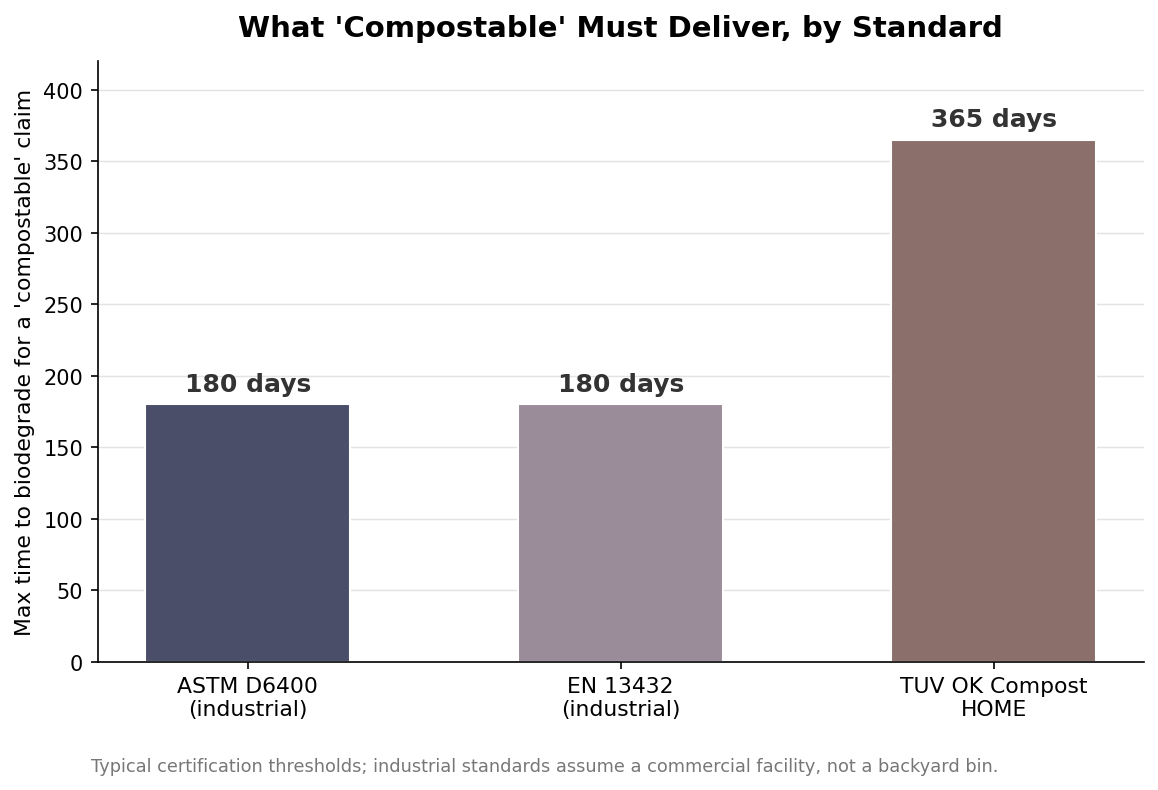
The critical distinction hiding in these numbers is industrial versus home. Industrial standards assume a commercial composting facility that reaches high, sustained temperatures; a home-compost certification like TUV OK Compost HOME allows a longer window precisely because a backyard bin runs cooler. A carrier certified only for industrial composting is genuinely compostable, but only where a commercial facility accepts it—which is why reputable products carry a caveat that such facilities may not exist in your area. Certification tells you what the material can do; local infrastructure decides what actually happens to it.
Recyclable in theory, contaminated in practice
Molded pulp carriers are made largely from recycled paper fiber, so on paper they slot neatly into the paper recycling stream. In practice, two things get in the way. First, food and liquid contamination: a carrier soaked in spilled coffee is often rejected by recyclers who cannot process wet, soiled fiber, even though the clean version would be accepted. Second, coatings: a paperboard carrier lined with plastic to resist moisture is far harder to recycle than uncoated molded fiber, because the lining has to be separated out. The upshot is that an uncoated molded fiber carrier is frequently better sent to compost than to the recycling bin, while a plastic-lined paperboard one may not be cleanly recyclable at all. Match the disposal claim to the reality of how the item leaves a customer’s hands—usually dirty.
PFAS and coatings: the fine print buyers miss
For years, fiber foodservice packaging often relied on PFAS—per- and polyfluoroalkyl substances—for grease and moisture resistance. Those “forever chemicals” have become a regulatory flashpoint, and a growing number of U.S. states now restrict intentionally added PFAS in foodservice packaging. This is the single compliance issue most likely to catch a buyer off guard, because a carrier can be certified compostable and still be a problem if it contains added PFAS. When you source carriers, look explicitly for a no added PFAS declaration, and treat it as a baseline requirement rather than a premium feature. Uncoated molded fiber generally sidesteps the issue; anything with a moisture barrier deserves a direct question about what that barrier is made of.
How the options really compare at end of life
Step back from the certifications and the environmental picture is stark. Uncoated molded fiber breaks down on a timescale of months, coated paperboard takes materially longer because of its lining, and rigid plastic carriers persist for centuries. The exact figures depend heavily on real-world conditions and should be read as indicative rather than precise, but the order of magnitude is not in dispute.
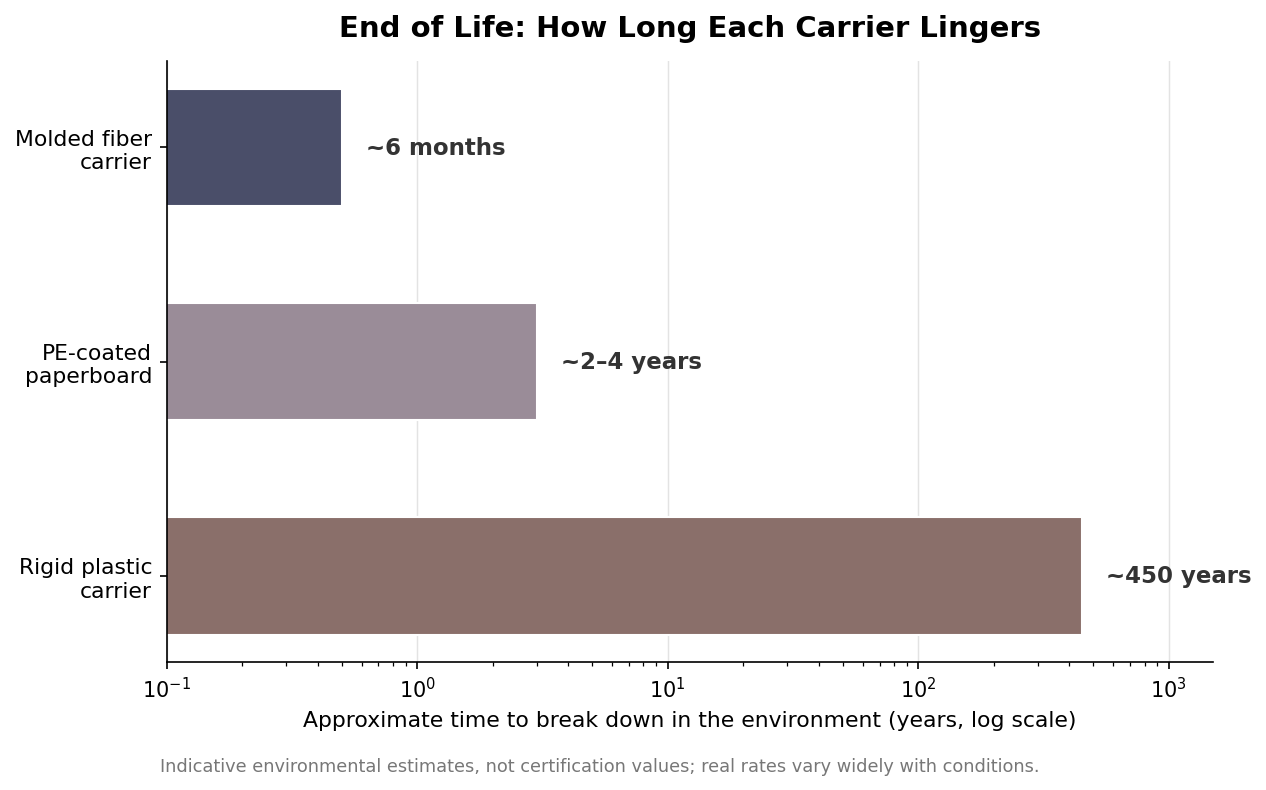
This is the comparison worth putting in front of a sustainability-minded customer, with the honest caveat that a compostable carrier only delivers its benefit if it reaches a composter. A certified-compostable tray that ends up in a landfill still beats plastic on its material footprint, but it will not compost in an anaerobic landfill the way it would in a managed facility. The environmental win is real, but it is conditional on where your waste actually goes.
Specifying a carrier that matches your waste stream
Pull the decision together around your local reality, not just the label. Decide whether your operation and your customers realistically have access to commercial composting, curbside fiber recycling, or neither, and choose accordingly: certified-compostable uncoated molded fiber where composting exists, clean recyclable fiber where recycling is the realistic path, and a no-added-PFAS declaration in every case. Ask your supplier for the specific certification standard and the composting conditions it assumes, confirm the cup-size range the carrier fits so it works across your menu, and keep any recyclability or compostability messaging you print on the carrier accurate to what a customer can actually do with it. Overclaiming on packaging is both a compliance risk and a trust risk; a modest, accurate claim backed by a real certification is worth far more than a bold one that falls apart under a second look.
Leave a Reply